
Times might be tough for FMCG companies right now, with soaring interest rates curbing consumer spending – but history shows that companies that invest in technology during tough times reap the benefits in the future.
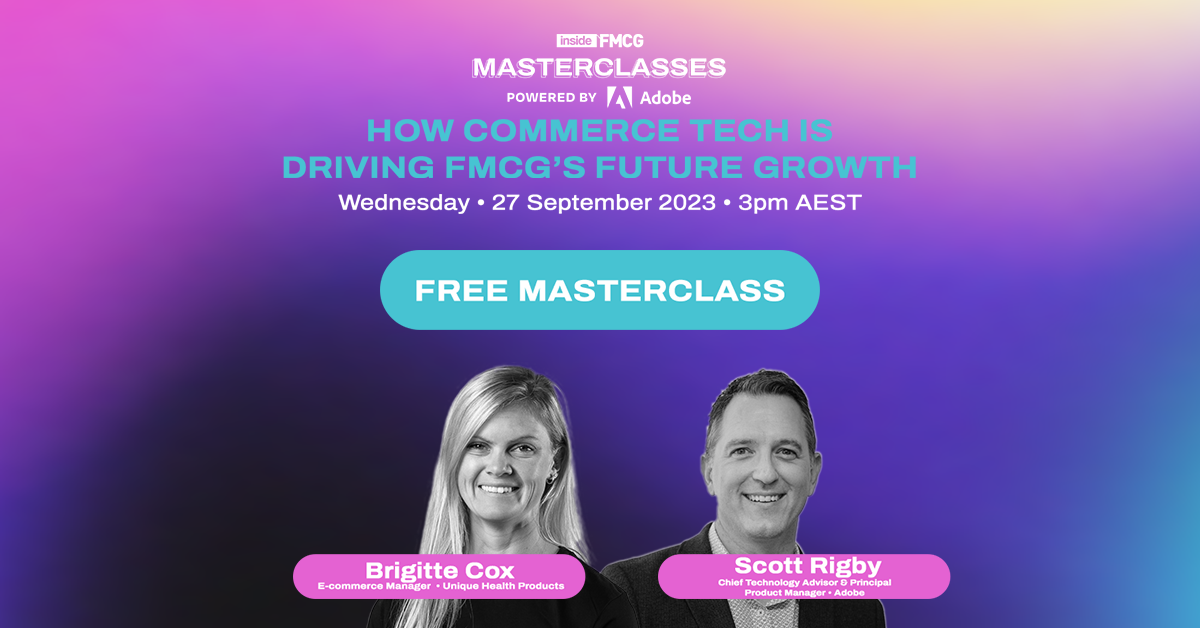
In a masterclass hosted by Dean Blake, print and features editor at Inside FMCG, Scott Rigby, Adobe Commerce chief technology advisor and principal product manager, and Brigitte Cox, e-commerce manager at Unique Health Products, shared experiences on the benefits of adopting commerce technology to improve customer engagement and sales in the B2B environment.
Rigby cited research by Harvard and the Kellogg School of Management off the back of the global financial crisis that showed while most of 5000 businesses surveyed cut their investment into marketing technology at the time, the 15 per cent who either maintained such investment – or increased it – came out of the crisis much stronger than those that cut their budgets.
There is a historical benchmark for this from previous downturns, explained Rigby: During the 1920s Rice Krispies increased its investment in technology, Pizza Hut did the same in the 1990s, and Lego went on a global expansion spree during the global financial crisis.
“This should indicate how they effectively broke away from those that actually decreased spending during that period of time. There is actually no better time than now to invest.”
While the timing of such investment is important, Rigby argued it is also critical to recognise that a new generation of executives is moving into procurement roles: Gen Z and millennials. They expect the same interaction and transactional capability that they have in their personal lives in their work lives.
“If you are not using commerce technology to be able to personalise and to be able to transact with your B2B customers, then ultimately, you’re going to be left behind,” warned Rigby.
“We know that 81 per cent of B2B buyers actively look for another supplier if they can’t purchase across any channel, and that obviously includes digital.”
How technology improves customer relationships
One company that has embraced the opportunity to deploy commerce technology in its B2B engagement with customers is Queensland-based Unique Health Products, which wholesales about 250 brands with 4500 products into about 5000 retailers Australiawide.
“In any one month, we’ve got between 50 and 80 brands offering deals,” explained Cox. Those deals could apply to only a few select items or an entire range; specific to every retail client or only a few – and they change every month.
Unique Health Products deployed Adobe’s solution to partially automate what was once a manual process of inputting data, setting price policies and checking deals with retailers. Now the company spends “a matter of minutes” to update all of its pricing each month.
A wholesale distributor of ‘better-for-you products’ ranging from food to homewares, Unique Health Products started out 25 years ago with the founder taking photos of products and putting them in a photo album with sticky notes showing prices. That was his catalogue. Later, the business evolved to phone calls and spreadsheets.
“But, it’s not like that anymore,” said Cox. “It’s a very different world that we’re living in and we certainly can’t operate as a national distributor with photo albums and sticky notes. So we had to make that transition into the digital space.”
The company’s customers include major grocers like Woolworths and Coles, health stores, pharmacies, marketplaces like The Iconic and Amazon, and smaller retailers down to health food stores and chiropractors. With such a broad range of business sizes and levels of technology, Unique Health Products had to be careful to maintain a personalised approach where clients expect it, such as allowing them to order by phone should they prefer.
“It’s really important in this day and age to take advantage of all of the technology that’s available out there to make sure that your business is doing everything it can to reach those new customers. You need to make sure that their buying experience from your business – whether you’re B2B or B2C – is as easy and as simple as it can be.”
The commerce technology revolution
Rigby says commerce technology is revolutionising the FMCG industry by driving cost efficiency while growing revenue by helping brands scale to more regions, channels and audiences. In an era when there is increasing fragmentation and complexity of customer audiences, technology can help businesses understand their customers better – even breaking macro audiences down into micro audiences. He says brands need to personalise and tailor the messaging, the products, the pricing for these individual buyer profiles and deliver unique experiences for each audience group.
Customers also want to be able to serve themselves at a time and place they choose. “They don’t want to be able to transact with you only from Monday to Friday, between nine and five. They want to be able to do it when they have time and they want it to be seamless. They also want ease of use, so that if they continue to order the same thing time and time again, they can do so with one click repurchase. You need to make it very simple for them to be able to interact with your business.”
But when it comes to serving audiences, many brands remain slow on the uptake.
“We have all this technology that’s slowing us down, and impeding our ability to provide seamless interaction and transactions with customers. Coordination across businesses can be quite challenging while we often have what I would call ‘legacy leadership’ who do not understand the urgency to make these rapid changes.”
Cox concurred, stressing that technology helps address the complexities of serving geographically diverse markets. As an eastern seaboard distributor supplying companies all over Australia, her company found technology helped it manage differences in what people in different regions buy, where they shop and how they interact with retailers.
She also stressed that deploying commerce solutions should not be done to allow a scaling back of human resources. “We’ve gone the other way: all of our digital resources have been implemented to help our human resources make sure that we still have those [customer] touch points all around the country. The technology to help them scale is very important.
“So, where you might have sales reps who at one point in time walked in with a folder and a couple of different Excel sheets, now they’re walking in with an iPad armed with reports and sales data. They’ve got the whole buyer profile at their disposal. So, it’s good to have the back-end technologies available for reps as well to help scale and to reach those new audiences and find different places to develop more business.”
Rigby agreed. “Sometimes we tend to see with B2B businesses a fear around the impact of technology on human resources, but it’s very rare that we’re seeing [people] automated out of jobs, rather the technology is augmenting what they do.”
He explained that where a customer might have questions about a product or an order, there is a much more focused conversation than before. Using technology means they can spend more time on customer relationships and developing new business.
During the Masterclass, backed by Adobe, you can hear Rigby and Cox discuss the rising adoption of direct-to-consumer commerce among FMCG companies, the development of marketplaces where brands – sometimes competitors – might collaborate, the impact of AI on the FMCG sector, and some case studies of how two multinationals have benefited from deploying commerce technology.
You can view the masterclass here – and catch up with earlier episodes.