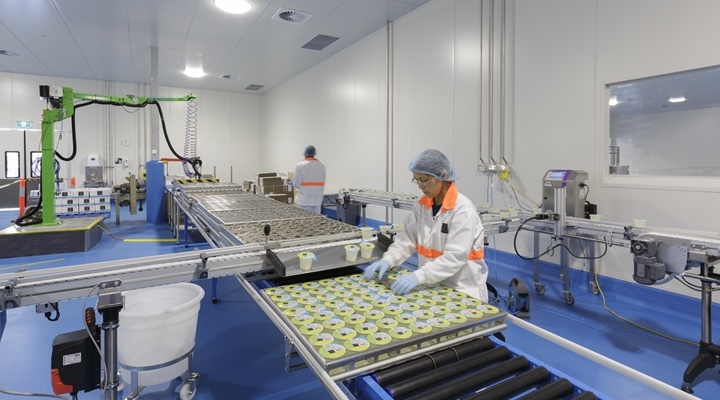

Expanding a food manufacturing operation has never been simple – but right now, it’s harder than ever. Construction costs are at historic highs, capital is expensive, and the pressure to grow hasn’t let up.
The good news: There are smarter, leaner ways to expand – ones that protect capital, preserve flexibility, and still deliver the growth capability your business needs.
Challenge the footprint first
A common and expensive misconception in the manufacturing industry is that expansion generally requires additional space. In many cases, improving design and layout can be more impactful than simply increasing the size of the building.
Poor layout, inefficient flow, and legacy process design frequently leave significant capacity locked inside existing four walls. Right-sizing begins at the design stage: Map your production process first, then build or adapt the space around it. Reducing the construction footprint – or eliminating it altogether – is one of the most powerful cost levers available.
Invest in the line, not just the building
More Australian manufacturers are shifting spend away from construction and toward the process and packaging lines themselves. For years, the default was to maximise the building and compromise on equipment. But it’s the equipment that determines how much you produce, how consistently, and how quickly you can respond when a major retailer asks you to scale up. Modern automation unlocks throughput that a manual line simply can’t match – making the case for a smaller, smarter building even stronger.
Use automation to drive revenue, not just cut costs
When businesses evaluate automation, the conversation almost always starts with cost: How many labour hours will this save? It’s a fair question, but only half the picture. The more powerful question is: If your factory could produce three or four times its current volume, could your sales team sell it? Could you land a new retail account, supply a private label contract, or crack an export market? Evaluated through a revenue lens, automation looks very different – and the manufacturers winning right now treat production capability as a commercial asset, not just an operational cost.
Identify all potential ‘new facility’ options
- Buy versus lease – an emerging trend is the rise of development companies and investment firms partnering with manufacturers to deliver new facilities on a lease-back basis. In this model, the third-party funds and delivers the facility, which the manufacturer then leases long-term. This approach can dramatically reduce the upfront capital required for expansion, freeing cash to be deployed into process equipment, automation, and working capital instead of being tied up in real estate.
- Brownfield versus greenfield: When selected carefully, brownfield sites can often be converted into world-class facilities at a significantly lower cost than greenfield developments, even after allowing for remediation works such as roof upgrades, improved lighting, or increased power capacity.
- Industry professionals versus builders – Partnering with experienced industry professionals can materially reduce risk, avoid costly mistakes, and deliver a compliant, high-quality facility that starts up on time and on budget. Early Contractor Involvement (ECI) is often favoured by construction companies, as it typically secures them for the duration of the project; however, in many cases, the absence of competitive tendering can drive higher construction costs, reduce cost transparency, and limit the client’s ability to challenge scope and value assumptions. The guiding principle remains the same: start with the process – the true revenue generator.
Stage your investment, don’t front-load it
The traditional model – build big, build once, grow into it – made sense when construction was cheap. Today, it ties up capital for years and leaves businesses carrying assets they’re not yet equipped to fill. A staged investment model is designed for what you need in the next two to three years, with a clear engineered pathway to expand as demand grows. The discipline is in the upfront planning – building in the right structural provisions and spatial logic from day one, so that the next stage can be added without dismantling what’s already there.
Plan for flexibility
Consumer trends move fast, and retailer demands shift. A facility purpose-built for one product range can quickly become a constraint. Building in flexibility from the start – through modular equipment, multi-purpose processing areas, and adaptable layouts – means you can respond to market changes without a major capital event. In today’s environment, that agility is a necessity.
Where to start
When expansion plans come under pressure, the greatest leverage is rarely in construction cost alone, but in making smarter investment decisions. Prioritising production capability and considering alternative expansion pathways can materially improve outcomes. For over 20 years, RMR Process has partnered with Australian food manufacturers to navigate these decisions with discipline and clarity. The approach is consistent: start with the process, protect capital, and build facilities that support sustainable growth.