
For years, Australia’s global cuisine grocery market has been polarised between two extremes: Specialist grocers offering authenticity, and mainstream supermarkets offering convenience and accessibility.
But May Wong, who finished her role as a category manager at Coles Group on August 31 and spent seven years managing an Asian grocery store, says that distinction is fast becoming obsolete.
A growing number of second-generation migrants are seeking food that reflects their cultural identity without wanting to choose between an authentic specialist store and a conventional supermarket.
They may be looking for the brands and flavours they grew up with, but also for products that fit easily into their everyday lives, Wong says during the latest edition of the podcast series Women Transforming Food.
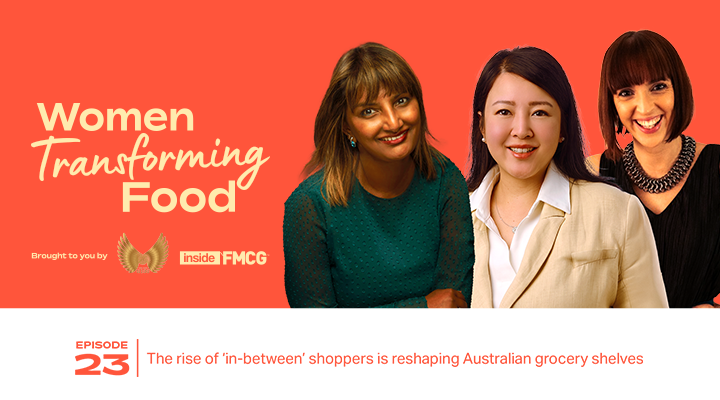
Sharing her personal perspectives with co-hosts Amie Larter, CEO of Octomedia, the publisher of Inside FMCG, and Angeline Achariya, Asia Pacific chair of the Food Systems Innovation and Resilience Wing, with the G100 Mission Million, she says this new category of “in-between” shopper represents an overlooked opportunity – a consumer group shaped by both cultural connection and mainstream accessibility.
In a market where ethnic food retailers cater either to mainstream, Western customers or to largely first-generation migrants seeking authenticity, May does not feel she belongs in either camp after nearly 20 years living in Australia.
“If anything, there are these underserved second-generation migrants that we are not really looking at. These are what I would call bridging customers that we are not really targeting.
“That is going to increase because migrants arrive and, like myself, have children and start their own families here. My children are going to be catered to Asian tastes, yet no specific retailer or product is really targeting this customer cohort. My husband is also second-generation Asian here, so sometimes an authentic grocer has too much to choose from, yet a mainstream store may not have what he wants. That is the middle ground I am observing.”
This ‘in-between market’ Wong highlights is already attracting multinational FMCG brands. For example, snack food brands are offering seaweed-flavoured crisps or cucumber-flavoured crackers, adding a little Asian flavour to a traditional Western product.
“Just as interestingly, I have seen authentic challenger brands who try to scale into mainstream distribution on their own terms,” continues Wong.
A general industry trend she has noticed as a shopper and grocer is that large Asian FMCG suppliers want to enter mainstream supermarkets and play in the global cuisine space. Suppliers are embracing that change. But their challenge is penetrating and winning market share. “That’s where it is important to build a brand architecture that can resonate with customers.
“In supermarkets these days, we see matcha flavours in almost everything. Goji berries, for example, used to be a very traditional Chinese well-being ingredient, but I am starting to see more and more in some stores, where they are selling and promoting them through a traditional Chinese medicine lens.”
Food is never just a product
Running her family’s Asian grocer, Wong learned that “food is never just a product”.
“A diaspora customer is buying authenticity. A traveller is buying discovery, and a mainstream shopper is buying a bit of adventure on a Tuesday night. People don’t relate to food rationally; they relate to it culturally and emotionally, and every range decision needs to capture that flavour. It is not just about units and margin, because there is also loyalty.”
Back in her independent grocer era, her customers were not buying a bottle of soy sauce; they were buying a taste of home. “They would drive across town to go to these special stores, passing three supermarkets, just for one specific brand their mothers used.”
Now, whether in her role as a category manager or as a customer, she visits food retailers often, observing independent grocers as a sort of discovery engine because they can experiment with new products and test demand.
In contrast, she has observed that mainstream retailers have to be more selective with what they put on their shelves, relying on “trustworthy” products that have already been market tested. While mainstream grocers need to focus on staple products, independent ethnic grocers are almost like an incubator for mainstream retailers, proving demand, she says.
“Independent grocers have a lot more room for innovation, a lot more room for launching new products, and ultimately, as it evolves, I do not think it is a zero-sum game. They’ll both be there, and shoppers will always cross-shop because there will be something you cannot find in a mainstream space, and vice versa; they will coexist.”
Wong personally believes that sometime in the future, global cuisine will probably not be a category; it will get absorbed into mainstream food categories.
“Think about pasta – it is Italian. Think about tacos. Technically, these are global cuisines, but they are already everywhere.”
Eating gyoza, cooking up a stir-fry, or a curry has become normal to many Australians. People who cook a bok choy stir-fry or a curry do not say they are going to eat Chinese or Indian cuisine. That distinction, she says, will ultimately vanish as such dishes become ordinary Australian staples.
- Listen to the podcast to hear Wong discuss the future of Australia’s booming global cuisine market and where retailers may be missing opportunities in the category.