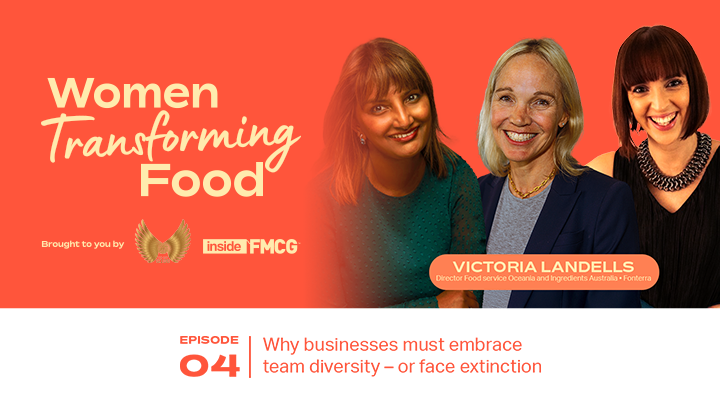

Diversity has become hugely important for any business and stretches beyond gender. And, as Victoria Landells, director of food service Oceania and ingredients Australia at Fonterra, explains, diversity is about a lot more than finding a balance between culture or lifestyle – it is a valuable tool in business development and fosters growth.
Landells defines diversity as everything from gender, religion, upbringing, and culture, how you think, a stutter, or a disability that will make a difference. “It’s about how people think, who we are, our experiences, and how we bring those to life.”
In the latest edition of the monthly podcast Women Transforming Food, Landells talked with Amie Larter, CEO of Octomedia, the publisher of Inside FMCG, and Angeline Achariya, chair, Asia Pacific at G100 mission million – food systems innovation & resilience. Women Transforming Food aims to explore the stories of inspiring women shaping the food industry.
“If we don’t embrace diversity and start to think, act, and do things differently, then as businesses, we will not have the joyous people working for us we need to have, and our businesses won’t be profitable. We don’t have a choice. We’ve got to think broadly. We’ve got to think differently, and we’ve got to change because if we don’t, we won’t exist.”
An unconventional career path can foster diversity
After working in hospitality, travelling abroad and then completing a degree as a dietician about the time she turned 30, Landells took a role managing a kitchen in a university hall of residence. Her career in the food industry includes working with the Food Standards Australia New Zealand as a food service technical professional before rising to her current leadership roles at Fonterra.
Landells says the brilliance of diversity is that it’s a trigger for change, and it brings in different ways of thinking. But she warns that if you are going to be consciously diverse, know that it comes with some challenges, and needs both careful thought and foundations.
For example, prepare for it to trigger conflict: You need to know your team well, know their shortcomings, and be prepared to have tough conversations when necessary because with diversity comes difference, and with difference comes conflict.
“You need to be able to have conversations about having conflict in a team, the power of conflict, the power of tension, and the building of psychological safety within the team to make that okay.”
Landells counters that by trying to focus on the team’s psychological safety, ensuring the team members understand each other.
She says that team culture – listening, caring, and respecting people for their differences – is really important. “I spend a lot of time on my team and talking to others and talking to my kids and my family and just generally people about the need to lean in, to care, to listen and to really set up whoever you’re talking to for success, whether it’s your team or your family.”
Landells advocates that achieving diversity relies on a leader’s approach to hiring. When hiring, the natural instinct is to look for someone with the same experiences that their predecessor or everybody else had – or the leader’s experience and skills.
“If I’m looking at employing, I’ll always look at someone who’s spent time at home and spent time out of the workforce. I’m interested in what they’ve done with that time, what they’ve learned from that time, and how they can apply that to a role. That’s super important. From a diversity perspective, particularly from a gender diversity perspective, it’s got to be acknowledged that it’s okay to have had time out of the workforce.”
Addressing harassment in a diverse workplace
Leaders must foster respect among members and ensure boundaries around acceptable behaviour and banter when building a diverse team.
There is no place for sexual innuendo, a jest about race or sexuality, or anything else and “it’s 100 per cent upon us to call it out if you see it” because if you don’t, then you’re as complicit as the person that’s making the statement or carrying out that action.
Landells’ approach to countering harassment was grounded in her experience when waitressing in a high-profile New Zealand restaurant aged 20. She arrived at work one day to find the maitre d’ wasn’t there. Her boss told her he had been put on leave after a complaint about sexual harassment. She recalls her shock because such actions were rare at the time.
“It rocked me because we worked in a fast-paced, amazing environment. It was a lot of fun. But there was a huge amount of sexual banter. And I don’t know whether it was just how we, as females, coped with it at the time, but we would just give back as much as we received.
“Reflecting on it, I realised I had enabled that person’s behaviour.” She also realised that while the person’s behaviour might not have bothered her at the time, it crossed the threshold of someone else’s sensitivity that was different to hers. “So their complaint was completely valid.”
Landell knew little detail of the complaint but considered it a wake-up call and realised she had a personal role to play. “I believe that we all have a responsibility for this kind of behaviour that’s happening at the moment or that we’re reading about.”
Fast forward, and some such behaviour endures today. “You are still having a drink after work, and it’s still happening. It won’t go away quickly because it’s been happening for 30 years. There’s no switch we can flick to change this, but we can start being way more purposeful around pointing it out, way braver around saying, ‘Hey, what you did there … for that person, it wasn’t okay.
“It’s definitely on all of us to make a difference and to stand up.”
- Listen to the podcast to hear Landells talk about the importance of skill sets and the kind of sparkle that someone can bring to a team that cannot be taught, why it’s important to step out of the default safe zone of hiring someone with the same experience as the hirer – and define the ‘imposter syndrome’.