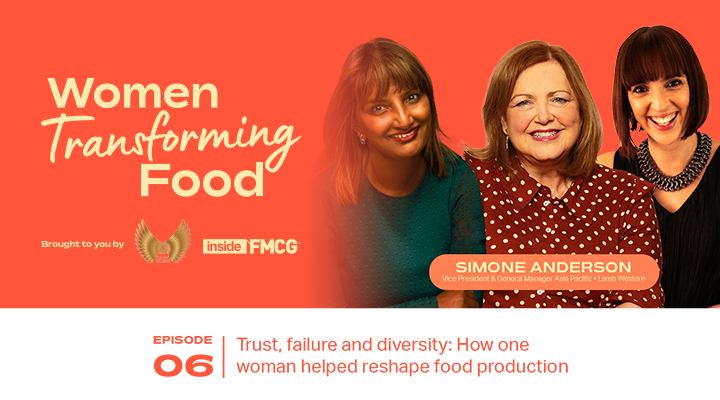

When Simone Anderson – VP and GM Asia Pacific at Lamb Weston – began her career, she was actively discouraged from working in the traditionally male-dominated food manufacturing industry.
“I persevered and got my way,” She told Amie Larter, CEO of Octomedia, the publisher of Inside FMCG, and Angeline Achariya, chair, Asia Pacific at G100 Mission Million – food systems innovation & resilience wing, in the latest edition of the monthly podcast Women Transforming Food. The podcast aims to explore the stories of inspiring women shaping the food industry.
Thirty years on, she has witnessed – and to some degree engineered – significant changes. From workplaces where pin-ups adorned the walls of the engineering workshop – completely unacceptable today – to more flexible working environments that allow women to balance family and work commitments, she believes the industry is more open than ever before.
“It has definitely changed to the extent that it’s more accessible for women.”
One enduring factor discouraging women from a career in food manufacturing is shift work, which can be tough for someone who is balancing a family and a career. Anderson addressed this at Lamb Weston by creating what she calls a ‘mummy shift’, which allows mums to drop their kids off at school in the morning and pick them up in the evening. “It worked well, encouraging women to enter the food industry.”
She also believes in making it fairer for women when it comes to promotion by considering that women want to balance family and career. However, she says, the industry is still not attracting enough women, especially in manufacturing.
“There are more women in the supply chain, which is an easier, more accessible place for women to get into, but on the manufacturing side – mainly because of the shifts – it can still be off-putting to women. We still need to do more work around that.”
Encouraging diversity
Anderson is proud of her record at Lamb Weston in fostering diversity and gender balance. Her self-styled approach has paid off. She has a phrase she quotes her team: ‘Bring your whole self to work’.
“What I mean by that is I don’t care whether you’re black, white, pink, gay, straight, female, male; I just want you to bring ‘you’ to work, and I want you to be comfortable. How I’ve encouraged that is it genuinely isn’t just gender. It genuinely is around people feeling that they can be comfortable talking about whether they’re gay or straight, whether they’re from a different culture, or whether English isn’t their first language.
“We’ve encouraged that in Lamb Weston by embracing a different way of thinking culturally and a different understanding of cultures,” she continues.
“From a gender perspective, we recruit the best person for the job. Again, it’s more the supply chain roles that we have real success, but we’ve got a complete balance. We have a 50-50 balance of male to female ratio. I’m proud of that. Manufacturing is still an area for further work.”
Anderson has worked in the FMCG and beverage sector for over 30 years, with brands including Cadbury, Mondolez, Patties, and Sunrise, before joining Lamb Weston, a global leader in the frozen potato industry. During that time, she has seen huge changes in the role of women in food production and learned that by leading courageous humans to tackle impossible challenges, they can have fun winning together.
“The food industry is a serious industry in terms of food safety, people safety, turning out a product that’s to specification. However, people need to understand that whatever role they’re playing – whether they’re in engineering, on the end of the line, or a supervisor in quality – they understand what the end game is and why they’re doing what they’re doing.
“I try to bring that to life for them so that if we are dealing with a particular customer, then we bring in that customer’s food for them to try, or we’ll give them vouchers to go and shop at Nando’s or Guzman Y Gomez so that they get to taste the product that they’re making. That’s really important.”
Purpose-driven management style
Anderson’s purpose-driven management style is to “keep it real, get stuff done, and be consistent. Overarching that is treating staff with kindness. “You can be a tough person, but you’re going to get far more out of people if you show kindness. I love the phrase ‘Love like you’ve never been hurt before’. Bring forgiveness and building fun into the everyday. People respond far more to having an enjoyable work life because we rarely work 7.6 hours. So, build that fun aspect in.”
Courage is the next element to instil in staff, she explains. “Encourage people to dream big and make mistakes because unless you make mistakes, you’re not developing as a person, and you’re not developing the business either because you’re risk-averse.”
In the last few years, Anderson has seen a shift in terms of innovation, with companies starting to think differently, being prepared to take risks and potentially getting it wrong, accepting they won’t get everything right, but encouraging teams that it is okay to fail and that failure isn’t a failure. “Failure is a learning experience and so to be encouraged. But so many businesses are afraid of failure and punish it.”
The final part of Anderson’s purpose-driven approach is building trust. “Honesty, keeping my word, making sure my team feels supported.”
The philosophy works: Anderson is still in touch with people she worked with 30 years ago and says the relationships she builds with people are personal.
“They’re not just work relationships. I talk about Lamb Weston as my extended family, which would be true for any role I’ve worked in. If you can make it real for someone, and they believe that you have their best interests at heart, and you demonstrate that and have honest conversations with them about how they can improve or what they’re doing … you get a genuine commitment from people that transcends work, and people trust you for life.”
- Listen to the podcast to hear Anderson talk about the importance of older generations learning from the younger ones – what she terms “reverse coaching” – and more about the concept of purpose-driven leadership.