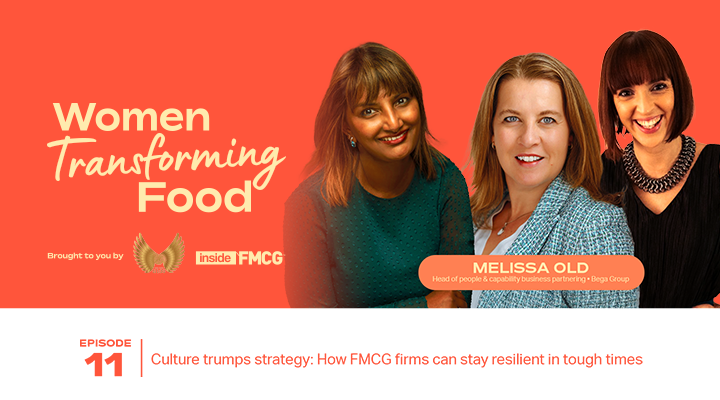

Culture is vital in keeping food organisations resilient, especially during an economic and geopolitically changing environment like the current one.
“The most brilliant strategy can fail if it’s not aligned with or supported by your organisation’s culture,” explains Melissa Old, head of people and capability business partnering at Bega Group. “And culture is led by senior leaders in the business, so it needs to be connected with your values and the organisation’s strategy.”
Old was a guest on the latest episode of Women Transforming Food, a monthly podcast from Inside FMCG and G100, which explores the inspiring journeys of women shaping the future of the Australian food industry. She reminded Amie Larter, CEO of Inside FMCG’s publisher Octomedia, and co-host Angeline Achariya, Asia Pacific chair of the Food Systems Innovation and Resilience Wing at G100 Mission Million, of a quote from Peter Drucker: ‘Culture eats strategy for breakfast’.
“That is so true. The role that culture can play in keeping food organisations resilient is to help provide guidance to people in the business so that they know what’s important. Culture helps to inform decision-making and behaviour,” shares Old.
“Fostering a culture of innovation and learning requires leaders to be clear on what’s expected and encourage the mindsets, the behaviours, and the capabilities that are conducive to innovation. One way that leaders can do this is by encouraging people to feel safe to speak up and to disagree respectfully. Encouraging diversity and seeking different views and ideas can lead to richer discussion, possibilities, and different ideas.”
Old believes that teams who feel psychologically safe to own up to mistakes or discuss projects that haven’t gone well, to be able to normalise that and reframe these as learning opportunities, reflect a strong internal culture.
“Culture is really strengthened through symbolism and rituals. So people look for signals around what’s valued. So I think if performance measures and rewards are linked to behaviours that drive innovation and learning, these are more likely to be adopted and embedded into the organisation.”
Examples might include experimenting with including learning opportunities in the weekly calendar. “That could be creating sandbox days or just opportunities for people to have some time away from the task through blue sky thinking time or development activities,” says Old. Or by building learning moments into regular team meetings or other formal business meetings. “It just really helps to make it more of a way of life rather than a once-off activity.”
Old’s advice is grounded in many years of experience as a leader in people and culture, with deep expertise in organisational development and leading transformational change. Her career has spanned Australia, New Zealand, Asia, the Middle East, and Africa, across the FMCG, pharmaceutical technology, and financial services industries. As Larter explains, Old has a deep passion for building high-performing teams, strengthening culture and coaching to develop commercial success.
She advocates FMCG companies adopt HR strategies that focus on talent, attraction, development, and retention, but recognise that this needs to be segmented according to your workforce profile or demographics.
For example, having flexible policies and practices that allow people to work from anywhere is something she is seeing increasingly often, even if it’s just for a few weeks a year.
“We see requests for people to want to work from other countries sometimes, if they’ve got family living there. So flexibility around where to work is important, and having clear pathways for people to progress, investing in learning that’s also flexible to suit different learning styles and developing leaders through stretch assignments are just some of the approaches that we’re seeing in the FMCG space.”
Foster growth mindsets in your team
With so many different generations actively engaged in the workforce, it’s important to be able to embrace flexibility and adapt in terms of how you communicate with, lead and motivate your teams, says Old.
Companies will stagnate if many people in the organisation demonstrate fixed mindsets because they are not challenging themselves, staying up to date with new technologies or learning new skills, says Old.
Conversely, people who lead with a growth mindset are much more likely to persevere. “They can learn from mistakes and often reframe failure as a learning opportunity. Smaller businesses should focus on cultivating that growth mindset as part of their strategy in building future leaders.”
She advises food businesses to foster among staff a willingness to learn, to be curious and self-driven. “Learn new skills, explore different technologies, and address your development gaps rather than being fearful or avoidant. This could be achieved through sharing your own learning moments.
Having leaders encourage development and career growth, even during these difficult times, can still show a level of care for a person beyond the role. It shows that you care about building their skills and their employability and want them to grow and be successful; that we are not just seeing them as a headcount, as a person.”
How flexibility can drive productivity
Since the pandemic, the goalposts have changed for both employees and job seekers, says Old. “They are in a much better position to command flexibility. The implication for HR in FMCG is ensuring your organisation has flexible policies and practices, which we might refer to as a three-way win. So does it suit the individual needs of workers, the organisation itself and its customers? The key point is that there isn’t really a one-size-fits-all approach anymore. People are unique. They have their own circumstances.
Organisations are more or less obligated to focus on how they can provide autonomy, flexibility and connection to purpose for their workforce. “Leaders play a key role in this by helping people understand where they fit into the organisation, how their role connects to the purpose, and ensuring that behaviour aligns with values,” she concludes.
- Listen to the podcast to hear Old explain how employers can balance the competing pressures of nurturing talent, fostering a strong organisational culture, and reinforcing brand purpose within FMCG teams, and how to guide staff through a company restructure.