


With FMCG and retail industry investment in AI already in the billions and growing at a compound rate of 30-45 per cent, competition has never been fiercer as we move into 2026.
The number one question from the hundreds of senior executives and board members who have attended Quantium’s Executive Edge programs over the past 12 months has been how to compete effectively in this AI era, and what they personally need to do as leaders to drive success.
In particular, they’re asking how to compete without investing tens of millions, how to navigate through the dozens of companies making AI generalisations, and how to ensure AI delivers in practical and tangible ways to accelerate internal efficiencies and priority growth plans.
Five tips for leaders to unpack:
1. Don’t let your size get in the way
The next 12 months will determine the next decade. A comprehensive analysis of AI adoption across Australia’s food and beverage sector reveals a stark 3:1 adoption gap between large multinationals and small local manufacturers, creating significant competitive disparities in the $138 billion industry. While company size undoubtedly shapes both opportunities and obstacles in AI adoption, there are clear pathways to succeed irrespective of your business size. Understand the best pathway for your business and get moving.
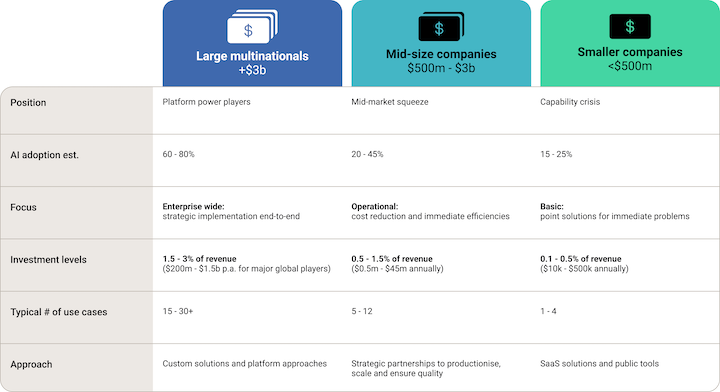
The table above reveals both the challenge and the opportunity. The 3:1 adoption gap is real. Large multinationals deploy 15 to more than 30 AI use cases enterprise-wide with $200 million to $1.5 billion annual budgets, while mid-sized Australian companies achieve only 20-45 per cent adoption with five to 12 applications on budgets one-tenth the size. This creates a compounding margin advantage: multinationals are more likely to secure the claimed five to 15 percentage points of EBITDA improvement through AI-optimised operations, while mid-sized players struggle to prove ROI within 12-18 months. For smaller manufacturers with just one to four basic use cases and $10,000 to $500,000 annual budgets, many remain uncertain how AI could help their businesses.
However, size doesn’t have to determine destiny – approach does. Mid-sized companies don’t need enterprise budgets to compete when they focus on strategic partnerships that deliver productionised solutions rather than expensive custom builds. A $100,000 to $300,000 investment in the right three to five high-impact use cases can match the operational efficiency of companies spending 10 times more, proving ROI within 12 to 18 months and funding broader deployment.
Small manufacturers can leapfrog the capability gap entirely through SaaS and managed-service solutions requiring zero internal expertise, accessing demand forecasting and optimisation tools with a three to nine-month payback. The companies that will lead Australian FMCG in 2026 are making their AI decisions in these next 12 months, moving from 15-25 per cent adoption to more than 45 per cent where competitive advantage begins. This is the pathway to succeed irrespective of size: Right partner, focused use cases, proven ROI, then scale.
A critical watchout: If the company you’re partnering with to deploy and scale AI in your business cannot provide tangible examples of how they’ve implemented AI solutions specifically within FMCG and retail, look for another partner.
2. Build AI literacy and change management directly from the top
The single greatest accelerator (and competitive equaliser) in this AI era is for senior executives to drive transformation top-down with equal measures of curiosity, determination, resilience, and not to wait for it to percolate up from the bottom. Irrespective of your company size, this is the single biggest lever you can pull. The coming year will require leaders to have a clarity of vision on AI and to back it up with their own actions and focus – this may likely be the difference between staying ahead of your competitors or not
At Quantium, we launched our ‘All In on AI’ strategy 18 months ago with a deliberate, CEO/LT-led mandate. Generative AI would be embedded into how every person works, every day, on every task. We challenged team members across all functions, from data analytics and engineering to sales to HR to accounts payable, to identify opportunities to leverage AI for their specific roles to drive both efficiencies and tangible business impact.
The results speak clearly. Today, 90 per cent of our 1200+ team members use AI daily in their roles, averaging 10-15 interactions each. Quantium is formally ranked number one globally by Anthropic, with more active daily users of Claude than any other company, surpassing even Anthropic itself.
In the first six months, over 100 different use cases were explored. We prioritised the most successful for hardening and scaling, delivering efficiencies ranging from 20-70 per cent. Tasks that previously took days are now completed in hours, allowing team members time to then focus on continuing to push technological boundaries.
The biggest business impacts have come from combining AI with human intelligence and the industry knowledge we’ve built over two decades.
3. Partner strategically with retailers on high-impact opportunities
Given Australia’s concentrated retail market, collaboration with retail partners on AI initiatives is essential, focused on the most significant challenges and opportunities for your business and categories. The dynamic is shifting fundamentally. AI is dismantling traditional barriers to extracting value from insights: capacity, capability, and cost. What’s emerging is a move from information asymmetry, where one party holds an advantage through superior data, to shared intelligence frameworks where both retailer and supplier work from common insights toward mutual customer value.
When AI equalises analytical capability, competitive advantage shifts to relationship quality, creative problem-solving, and speed of implementation. The question becomes not who has better data, but who can act on shared insights more effectively to drive customer value.
Leading partnerships are exploring co-developed category management approaches, collaborative forecasting through shared data environments, and joint capability building in sustainable applications—reducing food waste, optimising logistics. The focus: amplifying efficiencies and customer impact together.
4. Get moving now. Staying six months ahead beats waiting for the perfect strategy
The nature of AI development, with new models and capabilities emerging monthly, means any comprehensive three-year AI strategy will be outdated before the ink dries.
The key to success: Get moving with the immediate ambition of staying six months ahead of competitors. Delaying action while awaiting the perfect strategy only puts you further behind.
AI exists within the context of your current challenges: That pricing challenge with retailers. That promotional effectiveness problem. Is that product development cycle too slow? These are your AI opportunities, right now.
Start with your top three pain points where better insights, faster analysis, or automated processes would create immediate value. Run rapid pilots with clear success metrics – weeks, not months. When you find a use case delivering 20 per cent or more in improvements, immediately resource it for deployment. Use learnings to identify adjacent opportunities, building capability systematically.
5. Focus on questions, not just answers
One of the most interesting perspectives on AI’s role in business I’ve heard comes from Jeff Bezos, who said: “AI will only cost jobs in companies that run out of ideas.”
In an era where AI-generated answers can be cheap and plentiful, competitive advantage comes from asking the right questions specific to your business and cutting through the noise.
What creates differentiation is the depth of your industry knowledge combined with AI, leveraging your team’s brilliance to frame critical business questions, then pointing AI at them. Your ability to act on AI-generated insights. Your organisational capacity to implement AI-driven changes. Your willingness to experiment and learn faster than competitors. The companies that win won’t be those that run the most proof-of-concept trials. They will be those who most effectively combine AI capability with deep FMCG expertise, customer understanding, and execution capability.
At Quantium, our 23 years of retail and FMCG data expertise, combined with cutting-edge AI capability, create value that neither AI alone nor data alone could deliver. When we help suppliers identify opportunities or optimise strategies, it’s the combination of AI processing power and battle-tested industry knowledge that drives results.
That’s what determines whether AI becomes a competitive advantage or just another cost centre. Explore our AI Innovation Snapshot for retail and FMCG leaders here.
- About the author: Kylie Gleeson is CEO consumer (FMCG) and retail at Quantium.


