Australia’s organic milk market looks set to maintain its growth rate from 2018 to 2028.
In its latest study Fact.MR estimated that global sales for 2018 will increase by 440,000 litres from last year.
Demand for organic milk is expected to remain strong in the developed countries of Europe but there has also been a growing demand in the US, China, and India.
According to the report, these three markets are likely to offer good opportunities to dairy companies over the coming years.
Fact.MR revealed that the organic milk market is a consolidated landscape, with few players accounting for high revenue shares. The large players are focusing on product line extensions to meet growing demand. The tier II and tier III players are also focusing on joint ventures to increase their global footprint and capitalize on the emerging opportunities in new markets.
A growing awareness in the industry during the last decade has paved the way for more commercial opportunities for businesses. This comes to light despite the limited global demand for organic milk to particular consumers, most notably those who have higher incomes.
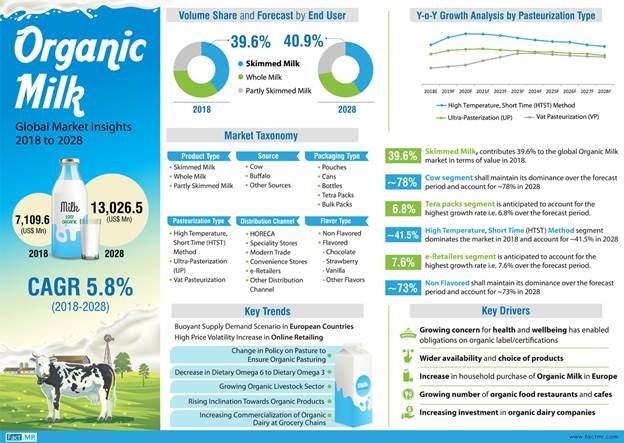
According to the Department of Health, partly skimmed organic milk is a good choice for babies as it’s easily digested and nutritious and studies show that sales are expected to see an upswing due to its high protein and calcium content. Partly skimmed organic milk is projected to expand at a relatively faster pace.
The milk market has seen businesses adopt clean labels with detailed ingredients including percentage of fats and other vitamins, but Fact.MR said that there’s a growing distress among small scale farmers on stricter regulations in emerging markets.
The latest research has shown that modern trade remains the largest distribution channel for organic milk globally. Modern trade involves supermarkets and hypermarkets which sell FMCG products, including organic product ranges that meet the increasing demand for organic milk worldwide. This has resulted in increased revenue for businesses.