
In the current economic environment with spiralling cost-of-living challenges, many businesses and their customers are unsurprisingly more focused on dollar value than the broader value components, like sustainability initiatives.
For Karen Job, whose role is to deliver the sustainability strategy of Australian supermarket giant Coles, the focus mustn’t stop. Businesses need to keep pushing and investing in improvements.
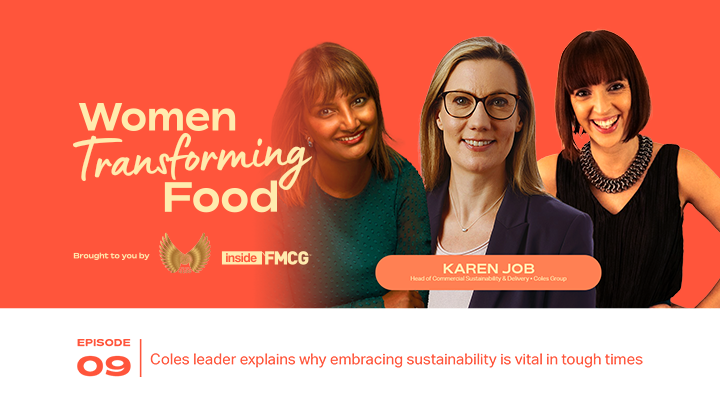
Speaking on the latest episode of Women Transforming Food, a monthly podcast from Inside FMCG and G100 that explores inspiring journeys of women shaping the future of the Australian food industry, Job says she is not worried that sustainability has fallen down the list of priorities for many.
“That’s no surprise. It’s to be expected, and it doesn’t worry me at all,” she told Amie Larter, CEO of Inside FMCG’s publisher Octomedia, and co-host Angeline Achariya, Asia Pacific chair of the Food Systems Innovation and Resilience Wing at G100 Mission Million.
“As Coles, we must continue to invest in things like our solar energy program and some of our sustainability initiatives, because you can’t just turn these things on next month. We have to keep going. Realistically, what happens is that sometimes the pace has to slow a little bit.”
Regarding sustainability, what customers say they do and what they actually do are often not the same.
She believes there is a role for sustainably marketed products, but the long-term solution is more about embedding sustainable practice into retailers’ businesses. “Frankly, that is exactly what my role is all about: embedding some of this into how we work.”
Coles has a supplier engagement target where the company is committed to engaging 75 per cent of its suppliers by spend to set science-based scope one and two emissions reduction targets. Success in this comes down to supporting and encouraging suppliers to come on board. “It is in no way compulsory, but there is this perception that [compliance] will increase costs. A big part of my role is to try and challenge that perception.”
Put simply, Coles is looking at how to use less fuel and less energy across its business and supporting suppliers to do the same. “If you take a slightly longer-term view, it should make us all more productive and efficient and do the opposite of adding costs. It’s really about how we get that across to the business.
“My role is all about helping my commercial colleagues to understand that, sharing case studies to try and understand whether someone might have done it well already and how we can help another supplier what we’ve learned in our business because we’ve got some manufacturing operations, how we can share some of those learnings.”
A career spanning the UK to Australia
Job has navigated the complexities of food retail in the UK, Asia and the Middle East with Marks and Spencer and in Australia with Coles.
She has dealt with the intricacies of product development to mastering food safety, sustainability, and commercial risk across every product category imaginable – including fresh, chilled, and ambient – and worked with small producers to massive manufacturing operations.
Job figured out she wanted to work in food technology at an unusually young age. Her father was a buyer with Marks and Spencer, so she grew up talking about his job at the family dinner table. When she was 15, she participated in a ‘Take Your Daughter to Work Day’. “It was so much fun,” Job recalls. “I met these amazing people called food technologists, and I was like, this is what I want to do.
“It’s an amazing profession because it combines science – which I loved, but I wasn’t a fan of the lab, and I didn’t like the lab coats – with a corporate commercial kind of world. I was never going to be a doctor or a vet or anything like that, so I got super excited.”
She “fell in love with it” after spending two days shadowing two inspiring women in food technology, one in an office and the other in a manufacturing plant, to give her a taste of both sides of the role.
Several decades later, Job says she still loves the dynamic and creativity of food manufacturing. “It’s so energetic and fast-paced, but my heart lies in retail, and it was all about that direct connection to customers.”
After a “fabulous” 10 years as a food technologist at Marks and Spencer she moved into the company’s international business for a further five, overseeing food safety and quality across M&S Food’s non-UK business – the Middle East, Southeast Asia, Hong Kong and China, as well as some Eastern European markets.
“That taught me how to work in isolation because during the first 10 years, I was very much part of a team. That is one of the other things about retail that I still love: That dynamic and that healthy tension between your colleagues, particularly with your commercial buyers and your food technologists, kind of that little tug of war is what makes the magic.”
Moving into sustainability
Job has been in her sustainability role at Coles for almost a year, a short span compared to her previous food technology tenure. One of her focuses now is a project called TCFD, a voluntary disclosure of Coles’ risks and opportunities, included in the company’s annual report, but which, from the 2026 fiscal year, must comply with the soon-to-be introduced Australian Sustainability Reporting Standard.
Regulation may sound “dull” to some, says Job, but she finds it super exciting. “It’s driving momentum to face these climate risks and opportunities, which is fundamental for business resilience going forward.”
To date, most of the work on this has been carried out by the legal risk and finance teams, but for the past six months, Job has been involved as well, in her role with Coles’ supermarket business. She is working to ensure the milestones and the roadmap are met, given that many of the climate risks and opportunities sit in the supermarket part of the Coles business. For example, how extreme weather events can impact the supply chain. Her role is translating what the legal risk team has done into the supermarket business’s day-to-day operations and how to make change happen.
“The only way we are doing it is through collaboration. Retail is not that different from many large corporates in that it’s very typical to work in silos where everyone is so focused on their own area. Having to break down those silos and genuinely work cross-functionally is challenging, but we need all those skill sets. We cannot deliver on our disclosures for this regulation next year if we don’t work together and recognise the different angles that everyone comes into the conversation with are what’s making the difference.”
- Listen to the podcast where Job talks about how vital collaboration is across businesses, suppliers, industry, retailers and government – and why it’s important to understand your values and your strengths.