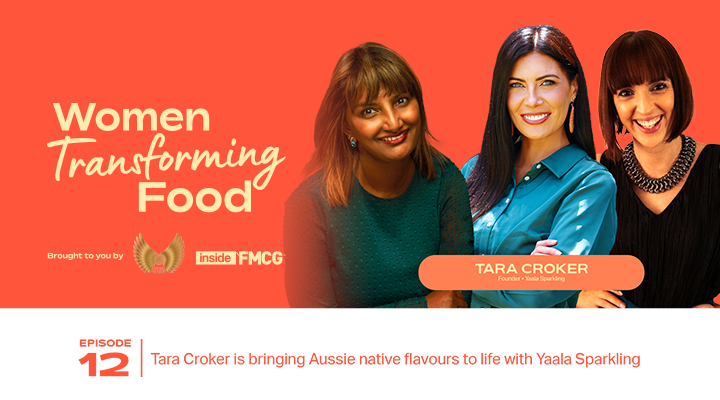

Australia has 6500 edible native plants, yet only a few have been commercially developed. Tara Croker has made it her mission to share the ancient knowledge of First Nations’ traditional plants, which have evolved over 60,000 years, and enable consumers to enjoy them in a modern way.
“It’s crazy to think that these plants are growing in people’s backyards across the country, and they don’t know what they are or the amazing flavours, benefits and nutrients that these plants have,” Croker said during the latest episode of Women Transforming Food, a monthly podcast from Inside FMCG and G100 that explores inspiring journeys of women shaping the future of the Australian food industry.
“It was important to me to champion these plants and share the knowledge that our elders have passed down for generations. I feel responsible to authentically and respectfully honour these plants and reconnect people to the land through these flavours.”
Talking with Amie Larter, CEO of Inside FMCG’s publisher Octomedia, and co-host Angeline Achariya, Asia Pacific chair of the Food Systems Innovation and Resilience Wing at G100 Mission Million, Croker shared her personal journey of reinvention – reinventing perceptions of Indigenous business, reinventing Australia’s relationship with native foods and reinventing her own career path from corporate to entrepreneur.
Croker is a proud Wiradjuri yinaa, and in her language, ‘yaala’ means ‘the present moment’. She created Yaala Sparkling to nurture her community with a healthy drink that combines flavours representing the different lands of our Country. “My vision is to respectfully share and bring to life the ancient flavours of our land in a modern drink for everyone to enjoy and have a conversation over.”
Launched in 2023, Yaala collaborates with Indigenous wild harvesters and local farmers to produce premium, healthy, native flavoured sparkling waters with health benefits. They’re sugar-free, low-calorie and have no artificial colours or preservatives.
Croker’s career path includes roles with global corporations, including Google, YouTube, and News Corp, a successful Shark Tank pitch and studying at Harvard University. Now she has embarked on her own entrepreneurial journey with purpose.
“When I started to notice non-Indigenous businesses using native plant knowledge in their products, I then discovered Indigenous representation in the native food supply chain is less than 2 per cent,” she explains on Yaala Sparkling’s website. “The fire in me was lit to turn the tables and show up in this space. Blak businesses start with a collective, sustainable and community-driven approach. This is more than a drink – it represents participation, equity and self-determination.”
The massive growth potential of native plants
Australia’s native plant industry is estimated to be worth approximately $80 million at present and is set to grow significantly beyond that in the coming years. “It’s a unique industry and we need to approach it right from a policy perspective.”
For example, Davidson Plums have 10 times the vitamin C of an orange. Lemon Myrtle is emerging as a new science, potentially serving as precursors to NAD (Nicotinamide adenine dinucleotide, a crucial coenzyme central to metabolism), and may have calming and anti-inflammatory properties. “They just are incredible. They retain everything that Mother Nature put into them to make our foods special and what our bodies need. And you compare that to apples and oranges, which have been GMO’d and commercially farmed.”
Croker wants to see protection around Indigenous cultural intellectual property. “It could look something like an Indigenous-led registry, perhaps where you got licensing to be able to use the plants, which then could funnel royalties back to different Indigenous communities and help support different projects and also to be involved in the industry.”
Royalties from Kakadu plums or Tasmanian mountain pepper, for example, could be reinvested in the community. “It would be great to see some stimulation around generating regional jobs in the industry, making funding, training, and opportunities available to different communities across Australia to be involved in the $80 million-plus industry built on Indigenous knowledge. We need ways to build that industry in regional areas to benefit Indigenous communities and ensure that they’re also involved.”
The importance of giving back
Croker is passionate about giving back to First Nations communities, building a business that serves as a ladder for others to climb, and creating economic pathways and opportunities for self-determination, led by culture, with First Nations storytelling at the heart of their brands and business.
“Giving back means many things. First of all, I think being a visible example to mob (a First Nations term referring to a group of people, often their family, kin, or community, associated with a particular place or country), to the community. Showing young women and young mob that it’s possible to build something beautiful and proud on your own terms and with respect to community and culture,” she explains.
“I’m using the business as a vessel to lift the community along the journey that I’m on and pay it forward as well with the experience that I’m gaining through my career, but also through the business. I’ve mentored quite a lot of young mob, more than 40 Indigenous high school students.”
Storytelling is a significant part of Indigenous culture, and a key component of Yaala’ strategy and reason for being. Croker aims to share the stories behind these plants and the cultural context associated with them. “I wasn’t seeing any brands honouring those plants and the culture, which is what led me to create something that I would love to see on the shelf. Our packaging, brand voice, flavour names, and use of traditional language will tell the story of the Australian land and the sacred meaning behind the plants,” she continues.
“We feature different female Indigenous artists for every flavour release we do, to authentically tell the stories and convey the symbolism associated with the real plants we use.
“That lands very well with customers because they are more conscious these days, as they are more educated about their purchases. They want to know what a brand stands for, and they’re going to align better with a brand that lives and breathes their values.”
Indigenous advisors must be embraced authentically
Croker advises entrepreneurs looking to use these plants or get involved in the native food industry to engage Indigenous advisors from the very beginning – not as a box-ticking exercise, but in an authentic co-design role from the outset, because you need to build long-term relationships with mob. “That’s how we work. We would like to sit down with you and get to know you, your story, and your journey.” Think in terms of long-term relationships, not fleeting, transactional engagements.
She is wary of brands that have tried to engage with mob, but turn out to be exploitative, “particularly with engaging elders and using images of our elders and making their brands look like they’re Indigenous owned when they’re not”. Such false representations lead consumers to think they are purchasing from authentic sources. “Be aware of that and engage meaningfully with the community and include the community authentically, not as a box-ticking exercise.”
Croker’s “audacious goal” is for Yaala to become the true drink of Australia, like Aperol is to Italy or Bintang is to Bali. “I’d love to see it be a symbol of local pride, served proudly in people’s homes, and something you pick up as a souvenir at the airport.
“It’s truly encapsulating the land, Australian cuisine, the plants, and the flavours that we have here.”
- Listen to the podcast for more about Croker’s journey, the importance of tenacity in business and the incredible opportunities for native First Nations plants in foods and culture.