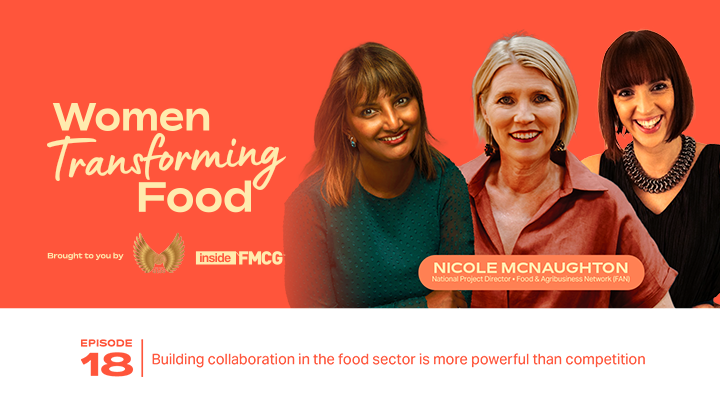

Nicole McNaughton is on a mission to put more local food on local plates across Australia – something she believes is crucial to a thriving local food industry.
“If we are not genuinely supporting the local food industry and supporting an ecosystem for those small, regional, local producers, growers I have a genuine fear that in the next 10 years, we won’t be seeing all of these artisan-style products and produce on our shelves,” McNaughton said in an episode of Women Transforming Food, the monthly podcast from G100 and Inside FMCG.
The vast majority of Australia’s food industry comprises small businesses, many of whose founders were from other industries or professions. McNaughton spent eight years with the Sunshine Coast-based Food and Agribusiness Network (FAN), which now counts more than 500 companies in its membership, the majority of them small regional businesses. For three of those years, she led the organisation.
FAN has grown into a thriving ecosystem where competitors become collaborators and isolated founders find their community.
Women Transforming Food’s co-hosts, Amie Larter, CEO of Octomedia, the publisher of Inside FMCG, and Angeline Achariya, Asia Pacific chair of the Food Systems Innovation and Resilience Wing, G100 Mission Million, talked to McNaughton about the value and opportunities from true collaboration – and how that requires openness and not shying away from vulnerability.
“The biggest gap I’ve seen is that pathway and to scaling their business from a great idea, a passion project or product into something that is commercially viable. And coming into the industry, you don’t know what you don’t know, and you don’t know who you need to know. Being able to follow a pathway and connect with the right support, the right like-minded people, is incredibly difficult for a small business.”
FAN, a not-for-profit, understands its members’ pain points and connects them with the right stakeholders, partners, and organisations to ease that pain, working with all levels of government, research institutions, and local and regional supporters of the food industry.
Now, through working with the Federal Government’s Industry Growth Program, McNaughton is taking this strategy beyond the Coast to a national organisation.
“Running a food business, with margins always tight, and input costs always rising, is incredibly difficult. So why would you look to compete with your competitors?
“I absolutely get that mindset, but we have lots of instances of specific collaboration.” She cited the craft brewing industry as an example. “They will be direct competitors with their own particular style of beer, but they come together because they realise they are [collectively] growing the pie, and their share of that pie against larger multinationals.”
Collaboration comes from sharing insights, sharing pain points, and experiences, she explained. For example, the Sunshine Coast’s local tourism office supports brewers by positioning the region as a craft beer capital, which really highlights what industries can do together. “It can be powerful; it is absolutely a mindset that needs to be nurtured.”
The key role of independent retailers
FAN works closely with the independent retailers, another example of the power of collaboration. “Our local IGAs are phenomenal. They support local, they support independent, they support small business, and together we’re growing the share of independent small regional businesses who are really the backbone of our region and so many other regions throughout Australia.”
McNaughton’s local IGA stocks products from more than 200 local food producers and growers. “It is always an incredible delight when you walk in and you see a new FAN member on the shelf. But at the same time, within the metro market, there are a lot more independent retailers, and fruit and veg stores who are supporting local.”
She counsels food entrepreneurs to reach out to all levels of government that are keen to support business growth. On the Sunshine Coast, for example, four regional councils run a multitude of diverse capability programs across many industries for SMEs. So does the State Government, and local industry groups.
“Once you start to scratch the surface, there is a wealth of opportunity out there. But I guess that also comes with complexity, because there is a wealth of opportunity, and as a small business, how do you come up for air when you’re in the kitchen or on the farm, and how do you navigate the wider ecosystem? I completely understand that. And I think that’s where our USP is at FAN. We are that kind of conduit of connection,” she said on the podcast.
“I guarantee you that there are many good-natured, willing people out there who want to see small businesses thrive and prosper. It is a matter of putting yourself out there and being open to those connections,” she said. “By being open and being vulnerable about your journey, you can connect with and learn a lot.”
McNaughton said larger FMCG companies can tap into innovation and insights so much quicker than having to delve into the latest global trends research reports. “True innovation lives within the small business, within the small startups. These are the businesses that have a truly phenomenal idea and are looking to scale.”
She sees larger businesses having an opportunity to access that innovation, along with some of the energy and “a re-energisation of why they are actually in the industry as a whole”.
FAN was founded by the big end of town coming together to support the growth of smaller businesses.
“We are incredibly fortunate to still have many large Sunshine Coast-based businesses supporting what we do. You can see when those businesses come to member meetups or events, connecting with smaller businesses, getting that energy back, and tapping into innovation and interesting ideas. As the Australian agri-food industry, we need to be able to support all sectors of the food chain to grow, prosper and thrive,” McNaughton concluded.
- Listen to the podcast to hear McNaughton share how her work with the Federal Government’s industry growth program is paying dividends for small food industry companies, the benefits of meeting and tapping into the knowledge of larger FMCG companies rather than seeing them as a threat, and how to engage with them.