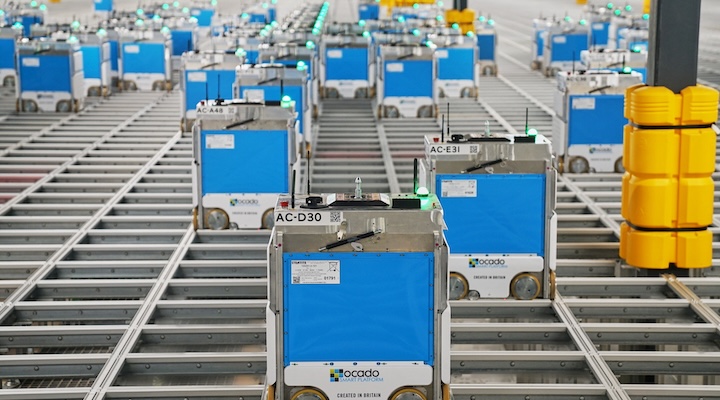

US retailer Kroger’s decision to close three of the eight automated warehouses it built with Ocado and expand its ties with the likes of Instacart and DoorDash highlights the challenge the British firm faces from rapid delivery firms.
Ocado sells its cutting-edge technology to retailers like Kroger, allowing them to pick and dispatch online food orders from vast robotic warehouses.
The setback with Kroger could put a question mark over Ocado’s ability to pick up more business from existing clients, and the potential for new tie-ups. The firm works with partners including Coles in Australia, Aeon in Japan and Lotte Shopping in South Korea.
But Kroger said on Tuesday that three of the warehouses had not met financial expectations, and that it would look to expand tie-ups with companies that not only offer faster deliveries but can be supplied from existing stores, thereby reducing costs.
“Consumers really want items that they’re ordering online to be delivered same day, and if possible, they would like to get them in an hour or two, if not sooner,” said Evercore analyst Michael Montani.
Same-day convenience
Ocado has seen its market value and revenues overtaken by DoorDash and Instacart operator Maplebear Inc in recent years, despite having had a head start on both.
While the British firm’s shares slumped this week, Instacart’s rose 5 per cent on the back of last week’s better-than-expected third quarter results, and are up over a third since its 2023 listing. DoorDash shares are up 21 per cent this year.
Montani noted that some of Ocado’s automated US plants were in areas where Kroger didn’t have a big store presence, making it harder to get a foothold. Others in states like Ohio had done better.
“Retailers are going to be doing more automation. It’s just that they’re trying to strike the right balance of speed of delivery so they can give that same day convenience, but then also get the efficiency gains of doing automation.”
Britain’s largest food retailers Tesco and Sainsbury’s have largely eschewed automated warehouses for their e-commerce services, preferring a store-pick model that has still allowed them to offer rapid deliveries.
Ocado’s rise and fall
In 2018, Ocado targeted 20 automated sites with Kroger, which helped to propel its market value during the home-shopping boom of the Covid pandemic briefly above that of UK industry leader Tesco. Since then, its shares have lost 90 per cent of their value and are down over a third this year.
Its Ocado Retail joint venture with Marks & Spencer – effectively its global shop window – is a bright spot and has been Britain’s fastest-growing food retailer for over a year.
Ocado pointed on Tuesday to Kroger’s decision to stick with five warehouses, and said it remained in talks over the further use of its technology to help the US company, while adding it still expected “significant growth” in the US market.
More work in the US?
Shore Capital analyst Clive Black, who has long been sceptical of Ocado’s model, said its capital-intensive model of distributing multi-temperature foodstuffs to dispersed customers was hard to make work financially.
He said it worked in affluent, dense urban locations such as central London, Manhattan and Paris, and possibly in markets such as Japan and South Korea. “But that is about it,” he said.
Peel Hunt analyst James Lockyer said Kroger would likely stick with Ocado for store-based automation, including potentially helping stitch together its deals with Instacart, DoorDash and Uber Eats.
“It would also make sense for Kroger to use the same provider to aggregate all of its e-commerce offerings,” he said.
He said another silver lining could be that Ocado’s exclusivity arrangements with partners are starting to finish, meaning they could sign up new grocery clients. However, new tie-ups in the US could prove tougher.
“We struggle to see Ocado getting further material partnerships in the US given the failure of the Kroger partnership,” said Bernstein analyst William Woods.
- Reporting by James Davey; Editing by Kate Holton, Adam Jourdan and Mark Potter, of Reuters.