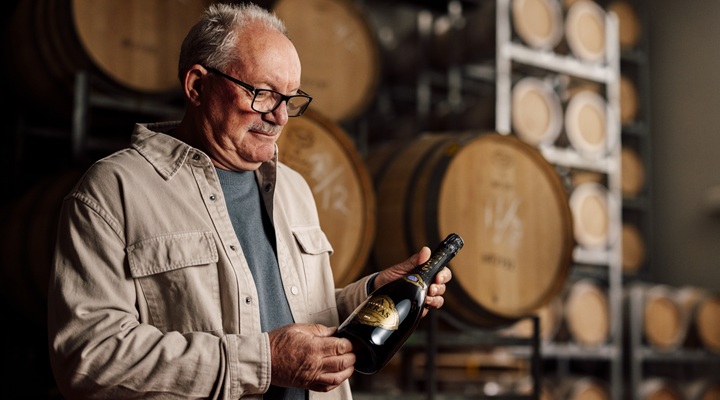

When the House of Arras EJ Carr Late Disgorged 1998 Magnum was awarded 100 points by Robert Parker Wine Advocate in March, it unsettled a longstanding assumption about where the pinnacle of sparkling wine resides. For decades, perfection in sparkling has been tethered, implicitly and explicitly, to Champagne. Now, a Tasmanian wine sits in that space. The review, written by critic Erin Larkin, carried a clarity that cut through any sense of novelty. “It is necessary for me to sit back and consi
Unlock indepth features,executive

Unlock indepth features,executive
interviews and quarterly magazines
SUBSCRIBE NOW
Already a Premium subscriber? Log in
Just for$39.95per year
When the House of Arras EJ Carr Late Disgorged 1998 Magnum was awarded 100 points by Robert Parker Wine Advocate in March, it unsettled a longstanding assumption about where the pinnacle of sparkling wine resides. For decades, perfection in sparkling has been tethered, implicitly and explicitly, to Champagne. Now, a Tasmanian wine sits in that space.The review, written by critic Erin Larkin, carried a clarity that cut through any sense of novelty. “It is necessary for me to sit back and consider all the great Champagne prestige cuvées I have tasted from this vintage in either the northern or southern hemispheres, and I cannot bring to mind a better example,” she wrote. The score marks the first time an Australian sparkling producer has achieved a perfect mark from the US-based publication, which has shaped global wine perception since 1978 and popularised the 100-point system. The winery now joins a small group of Australian names, such as Penfolds, Giaconda and Torbreck, that have reached that threshold, although none of them, until now, have done so with sparkling.For Ed Carr, the chief winemaker whose name is embedded in the 1998 wine bottle itself, the result carries a different weight. “Robert Parker is widely known across the industry to be the world’s most influential and respected wine critic,” he said following the result. Speaking to Inside FMCG, he added “This result firmly places the House of Arras amongst the top echelon of sparkling winemakers around the globe.”Carr’s career is a long, continuous line that runs through Australian sparkling wine from the early 1990s to the present, anchored in a belief that Tasmania could produce wines capable of both distinction and endurance. Since 1995, Carr has guided House of Arras with consistency, albeit through ownership changes, stylistic pivots and commercial pressures that would traditionally fracture continuity. The brand itself has moved, most recently sold by Accolade Wines to Handpicked Wines in late 2023, yet Carr’s presence has remained the constant, with production continuing under his direction.His philosophy has not shifted in any dramatic sense. “The vision for the brand has remained unchanged since its inception in 1995, hence the fundamentals have not wavered,” he said. What has changed is confidence, particularly in time. “Over the years, our confidence in the ability of these wines to mature gracefully with time has grown and we continue to increase our aging policy.” The 1998 Late Disgorged is the most literal expression of that confidence, crafted from Chardonnay and Pinot Noir, hand-harvested and produced using the traditional method, the wine spent 24 years on lees.Carr resists the idea that a wine is “made” at any single point. “I believe the final style and quality are the result of every step in the crafting of that wine. It is the total attention to detail that will maximise the quality,” he explained. The steps he lists are deceptively simple: Vineyard selection, tirage maturation to world-leading standards, low dosage and traditional cork. It is, in effect, an argument against shortcuts.Tasmania as materialTo understand House of Arras is to understand Tasmania. The island’s geography offers a convergence of factors that few regions can replicate. Cool-climate vineyards are in abundance from the north through to the east coast and the south, influenced by the Roaring Forties and the Southern Ocean. The result of the brooding landscape is fruit that retains the acidity, tension, and aromatic precision that are essential to high-quality sparkling wine. Carr saw Tasmania’s unique cold climate early. “Since the 1990s, Tasmania has been at the leading edge of premium sparkling wine making within Australia,” he said. Other makers followed, drawn by the same conditions, but House of Arras took a more specific view of what that fruit could do over time.“Many producers have recognised the potential of the viticultural resource and have become part of the new wave of premium sparkling wines. However, we recognised the amazing potential of our wines to evolve with extensive tirage maturation to a new level of style and quality.” Extended aging has become the defining characteristic of the house. It is also one of the most difficult to scale. Time is not easily accelerated and, to many, extensive aging can appear commercially inefficient. Yet it is the House of Arras team’s commitment that resulted in the 100-point result.The vineyard base itself is diverse and House of Arras draws from a network of premium sites across Tasmania, a tapestry of locations that allows for blending decisions that are both complex and precise. Chardonnay, Pinot Noir and Pinot Meunier form the backbone, mirroring Champagne varietals but expressing the distinctive Tasmanian climate.An accumulation of decisionsSparkling wine, particularly in the traditional method, is often described in terms of a process consisting of base wine, tirage (sugar and yeast added to a still base wine), lees aging, disgorgement (when sediment is removed from the bottle) and dosage. Each stage carries its own technical demands. What Carr suggests, however, is that none of these stages is decisive on its own. “The final style and quality are the cumulative result of every step,” he explained. This view reframes the craft, focusing on sustained precision.At House of Arras, this is visible across the portfolio. There is a through-line of texture, complexity and what wine critic James Halliday extolled as “such beautifully made wines, they are just a pleasure to drink”. Notable examples from the vineyard include the non-vintage Brut Elite, the Grand Vintage 2014 and the EJ Carr Late Disgorged 1998, with a more layered, savoury complexity and finer mousse.House of Arras has achieved a series of accolades across both domestic and international competitions and has been invariably recognised at the Champagne & Sparkling Wine World Championships. Carr, himself, was named Sparkling Winemaker of the Year at the International Wine Challenge in 2024, the first Australian recipient of the award. In 2018, he received a Lifetime Achievement Award at the Championships and remains the only non-Champenois winemaker to be honoured.The 100-point result is set to cause a re-evaluation within the Australian wine market, most likely in sparkling. Australia is recognised for still wines, with the Barossa, McLaren Vale and the Yarra Valley influencing global perception. Sparkling, even though present, has often occupied a secondary position. However, Tasmania, with its cool climate, has altered that dynamic over the past two decades, attracting investment from a whirlwind of global players, while French Champagne houses such as GH Mumm are now making Tasmanian wines.Throughout this, Carr’s focus remains studied. “Protection of our reputation is key to the future success,” he said. Vineyard plantings in Tasmania have increased, and the island is now widely regarded as the centre of Australian sparkling production. With that comes pressure and the task of maintaining integrity in the face of growth. Carr answered directly. “Our business is focused on quality, rather than quantity, and although we welcome the growth in Tasmanian vineyard planting, the House of Arras will be very selective with any expansion of our resource.”An Australian voice in a global conversationThere is a tendency, when a non-Champagne sparkling wine achieves recognition, to frame it as a challenger. Carr rejects that binary. From the outset, instead, the ambition was an accumulation of ideas. “The ambition has always been to achieve both of these goals,” he said, referring to creating a distinctly Australian expression while also standing alongside the great wines of the world. “They have become fundamentally intertwined.” The duality is captured in the brand’s own phrasing “internationally acclaimed, uniquely Tasmanian.”The 100-point score crystallises the position that the highest level of sparkling wine is not confined to a single region, even one as historically dominant as Champagne. It also bolsters the idea that Australian wine, especially when it operates at its most precise, does not need to approximate European benchmarks. The work continues along the same trajectory for the House of Arras team. The methods remain, the vineyards remain and the belief in time remains. In the end, the 1998 Late Disgorged signifies a record of decisions made over decades, held in suspension, then released at a moment when the category itself is ready to be read differently.