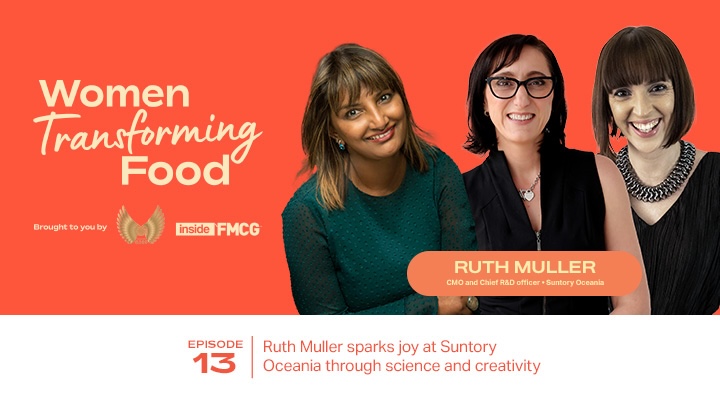

Ruth Muller has a passion built over 25 years for creating products that create “real moments of joy and meaning” for consumers. As chief R&D officer and interim chief marketing officer at Suntory Oceania, she oversees the development of beverages, including V energy, Suntory Boss Coffee and Maximus.
Muller finds her role energising because, to her, food isn’t just fuel – it’s about connection, hospitality, love, and the sharing of cultures.
“We are not solving world peace,” she tells the CEO of Inside FMCG’s publisher Octomedia, and Angeline Achariya, Asia Pacific chair of the Food Systems Innovation and Resilience Wing at G100 Mission Million, “But we are helping to create moments of joy for people.”
Muller was a guest on the latest episode of Women Transforming Food, a monthly podcast from Inside FMCG and G100, which explores the inspiring journeys of women shaping the future of the Australian food industry.
While Muller’s career began as a chemist in the skincare industry, after she made a short-term transition to food for experience, she quickly realised that was the field she wanted to spend the rest of her career in.
“I was inspired by the passion that everybody working in food seemed to have.”
At Suntory Oceania, Muller aims to create an environment that enables team members to excel by identifying and using their strengths to achieve a shared vision, all while embracing the diversity of individuals.
She brings to the role a deep curiosity about consumers that inspires her to keep asking and digging until she gets a clear picture in her head of a product opportunity. There she synthesises the data and helps provide direction to the team.
One of the biggest lessons of her career to date has been how essential it is to blend research and development with marketing, and the obvious synergy she sees between the two disciplines.
“Marketing and R&D are both an art and a science, but the actual science and the capability are quite different. They share some commonalities, but there are also differences.
“You always need to have a level of tension between marketing and R&D because if you don’t, then sometimes the influence of marketing can downplay the long-term thinking of R&D, which is very important. And R&D can have lots of ideas, but they might not be strategically grounded.”
Muller sees four key areas where the disciplines must be “joined at the hip” in order to deliver great products for people.
- Consumer obsession: “It’s got to start with the consumer, and you’ve got to be genuine about it.
- Innovation: This is about turning creativity and creative thinking into something of value.
- Commercial grounding: There must be a path to achieving a return on investment and ensuring that the ideas have market relevance.
- People: “This is around fostering an environment where collaboration and creativity thrive.”
“It’s important that R&D and marketing are always encouraging people to think differently and challenging each other so you can get to those better outcomes.”
Muller also believes it is a critical part of any innovation process and of functional teamwork that individuals feel confident about speaking out and sharing their opinions. Her team is free to disagree with her assessment of consumer needs. “And often they’re closer to this, so we get better results.”
Inspired by a master
Suntory’s founder, Shinjiro Torii, has been an inspiration for Muller. “Shinjiro Torii started out trying to make wine, and it took a while to get it right; it was so new for Japan. But he persevered. And then he did the same thing with Japanese whiskey. It would take years or sometimes even decades to get to the point where it was working, but he was so determined. He would have been in an environment with naysayers around him, saying, ‘No, you can’t make whiskey in Japan.’ But he persevered, and that must have been hard.
“One of our leaders said to me once, ‘If you ever feel discouraged or find it hard, just think about Shinjiro Torii and how hard his journey must have been, and that he persevered.’ I feel quite inspired by that story.”
AI is an enabler, not a replacement for people
Muller is excited rather than intimidated by the potential for technology – especially AI – to play a greater role in product development.
There are things that will change and things that won’t change, but the need to build brands won’t change.
We will always need that connection, and we will need that humanness even more. That is going to be the same, but the way in which we deliver things will change dramatically.
Creativity will become more important. AI tools can be very good at the mechanical, standardised processing capacity, but in terms of being able to do things in a new and different way, human creativity combined with digital tools and digital resources, are where you really see the magic happen because you can have the thinking and have the ideas, and then you’ll have that computational power behind it to [accelerate] things.”
Muller believes that people are talking about the efficiency AI enables – to be doing tasks faster and potentially reducing headcounts. But she believes it will help enable more value creation and opportunities as opposed to efficiencies.
“You definitely still need to build that efficiency in, but you’ll be able to do so much more with the tools we have that’ll take you in an entirely different direction, and the value creation you can get from that will be amazing. We will probably not need fewer people. If anything, there will continue to be a talent shortage.”
But she believes in bringing people along on that journey in a way that nobody gets left behind, because their skills will need to evolve. That might necessitate changing the structure of resources.
“AI will change a lot in terms of how we work, but the core of what marketing means and building brands will continue. AI is going to have a dramatic impact on value creation and how different companies are leading.”
To Muller, that means ensuring she works for a company with ethics and is actually using AI for good.
“The thing about Suntory is that because it has such a big focus on giving back to society, I feel the more we learn here, the more positive impact the company can have.”
- Listen to the podcast to hear Muller talk about fostering an emotional connection between people and brands, about creating an environment where teams can flourish across disciplines, and the importance of brand health tracking in the overall performance evaluation of products and brands.