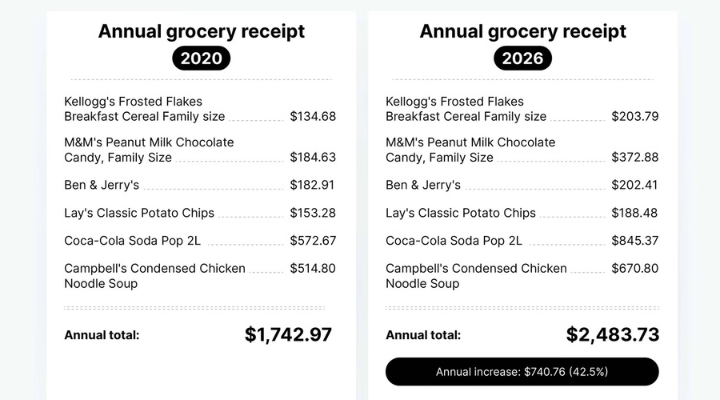
Research shows Americans are now paying an average of $741 per year more compared with 2020 to buy the same groceries, thanks to reduced package sizes.
InvestorsObserver has monitored the prices and weights of products that American households continue to buy, including brands such as Frosted Flakes, Doritos, Coca-Cola, Campbell’s soup, and M&M’s. While the brand names remain unchanged, the bills have increased, and in many cases, the pack sizes have shrunk as well. When pack sizes decrease, yet the price rises – or stays the same – that’s termed ‘shrinkflation’.
The research was planned to determine just how much shrinkflation has impacted US consumers over the past six years.
Coca-Cola and portion sizes
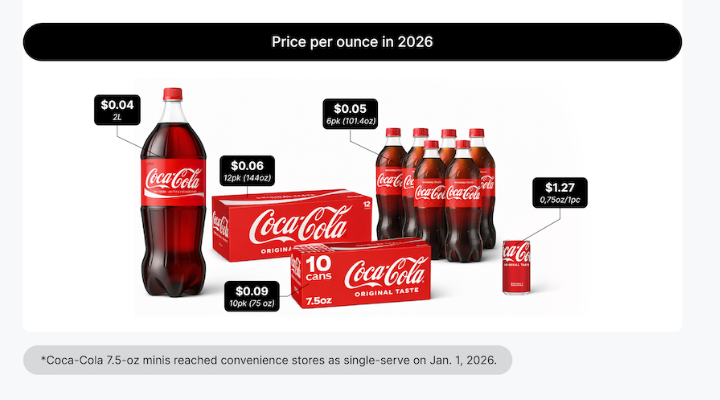
The data showed that the same Coca-Cola beverage is sold in several sizes at different prices. The brand has been accused of exploiting consumers through the pricing of 7.5oz mini cans, which cost more per ounce than larger formats.
A two-litre bottle cost US$1.89 in 2020 and now costs $2.79. A 12-can pack rose from $4.89 to $8.89. Consumers who buy mini cans pay more per ounce than those who buy larger bottles. In January, Coca-Cola expanded mini cans nationwide and described the move as “portion innovation”.
“The simplest advice we can give any Coca-Cola drinker right now is to buy the 2-litre. Our data shows it’s the best value format by a wide margin, and that gap has only grown since 2020. The mini can costs more than twice as much per sip. Most people had no idea,” said Sam Bourgi, senior analyst at InvestorsObserver.
Two-step strategy
The data show that several brands used a two-step strategy: Raising prices first, then reducing package size. Doritos, Frosted Flakes and M&M’s followed this pattern.
“It is a lot more difficult to notice changes in size than in price. However, shrinkflation can have an enormous effect on low-income households, where every dollar, every ounce, and every serving matters,” Bourgi said.
Doritos, for example, increased in price before the package size was reduced. Frosted Flakes followed a similar path, with smaller boxes introduced after price increases. M&M’s recorded a 102 per cent increase in price per ounce over the period. By contrast, Skittles and Reese’s Miniatures kept the same sizes while raising prices.
Prices stabilise, yet sizes do not return
According to Bourgi, shrinkflation can affect consumer decision-making. When companies raise prices and then reduce size, consumers lose information needed for comparisons.
By 2025, most prices stopped rising but remained above 2020 levels. Several brands held prices steady, while a small number recorded declines. Package sizes did not return to earlier levels. Products reduced between 2022 and 2024 kept smaller sizes, and no brand restored previous volumes.
Ice cream brands followed a different pattern. Ben & Jerry’s, Breyers and Häagen-Dazs raised prices over six years without reducing package sizes.
“That matters because it proves the shrinkflation strategy was a choice, not a necessity,” Bourgi said. “If rising costs forced brands to shrink packages, every brand would have done it. They didn’t.”
Limited visibility of shrinkflation
Shrinkflation can be difficult to detect. Consumers tend to notice price increases when managing budgets, while changes in package size receive less attention. Data shows consumers react more strongly to price changes than to size changes.
“No one is surprised by growing prices these days, but the issue with shrinkflation is the silence around it. You can clearly see when gas prices grow or rent rises – but in this case, you don’t notice when you start to overpay for less. It lands hardest on those who can afford the least,” Bourgi said.
Data show responses to shrinkflation vary across age groups. Baby boomers (70 per cent) identified more cases than Gen Z (48 per cent) and millennials (54 per cent). Gen Z reported the highest share of respondents who stopped purchases due to shrinkflation (80 per cent).