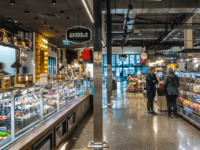
Nearly every one of us buys our food in a supermarket. Usually, it is the footprint of a standard suburban supermarket: 1500-4000 sqm (around a quarter of a footy oval).
Unlike the ‘80s and 90’s, you probably can’t visit the cafeteria anymore; there’s no butcher, and while there’s still a deli or bakery, nothing’s made from scratch.
Lately, you might have seen more supermarkets – especially in the inner city – that are smaller, without parking and built under a new block of apartments.
But you won’t have seen a ‘dark store’ before, because we are not allowed into them. The only people inside are ‘pickers’ who manually collect items off shelves to fulfil online orders.
Now there is a new form of supermarket: A ‘fulfilment centre’ made for robots, autonomously collecting items from purpose-built shelves along aisles too narrow for humans. The robots are picking groceries that your AI agent has ordered on your behalf.
It might sound exciting, or terrifying, but what we’re most interested in is what happens next. Will we trade choice, autonomy and our health for convenience? And will we even have a say when huge corporate profits are at stake?
Your (great) grandparents’ supermarket
Let us back up a bit. Buying groceries at a big supermarket is a relatively new phenomenon. Prior to the early 1900s, you would have done your shopping in the small, family-owned butchers, bakeries or greengrocers that lined our high streets.
Australia’s first documented urban grocers began to emerge in the late 1830’s, like W J SStacey Grocer or Smith, Peate & Co, Shipping & Family Grocers.
A clerk would do all the picking for you; you’d just hand over your grocery list and wait for them to sort it out.
You couldn’t select your own groceries in Australia until the 1920s, first with Brisbane Cash and Carry and then Farr’s of Newcastle.
A growing suburban market
In the post-war years, more people owned cars, and more women were working, which meant a weekly commute to the grocery store.
Appliance ownership increased during the 1950s-1970s due to greater access to consumer credit and hire purchase, so dairy, meat, fruit and vegetables could be stored for longer.
The small stores survived as milk bars for a few more decades because they were exempt from restrictions on weekend trading. From the 1970s, convenience stores started popping up too.
A new(-ish) world
And now, it’s back to the future. As apartment living becomes more common, there are more small-format stores like IGA Local Grocer/Express, Woolworths Metro or Coles Local opening on the ground floor of new buildings.
More than one in four households are now occupied by a single person, up 50 per cent since the 1980s, and the number of family homes is shrinking, which means we’re moving back to the small, frequent shopping trips of the 1800s.
Cross-store shopping across two or three retailers in a week is now the norm.
The digital grocery run
Chances are you’re one of the 23 per cent of Australians who’ve shopped online for your groceries. It is probably a post-Covid-19 habit. Before then, online sales at Coles and Woolworths hovered at 4 per cent or less. Now it’s at 11.3 per cent and 16.6 per cent respectively.
In May 2026, Coles CEO Leah Weckert told the Australian Shareholders’ Association conference that online grocery shopping could grow to roughly 30 per cent of total sales.
Delivery and click-and-collect are actually hugely unprofitable for supermarkets, as they require up to 125 per cent more labour.
Essentially, supermarkets are paying workers to replenish shelves, only to pay another worker to take that same inventory off the shelf and assemble an order.
Recently, Harris Farm partnered with Amazon for a direct-to-home grocery service, and Aldi partnered with DoorDash to fulfil deliveries, suggesting the online space has become the fastest-growing part of the sector – expected to grow at over 20 per cent through 2026-2034.
The hidden supermarket
So now, we arrive at the dark store. Both Coles and Woolworths have been investing heavily to reduce costs. In a dark store, the layout is dictated by data, not marketing, meaning a picker may be able to fulfil an entire order in under two minutes.
The next step is to simply get rid of the humans.
Special warehouses called customer fulfilment centres use a grid system with hundreds of little automated robots, whizzing around picking items. It’s incredibly efficient, a 50-item order – roughly your full weekly shop – takes a robot around five minutes.
The future of food and grocery competition will be fought on speed, not price.
Australia’s ‘quick commerce’ market is projected to grow at more than 22 per cent annually from 2024 to 2029 as the retailers fight it out to get groceries to your door in under an hour.
A bold prediction
So, if robots will pick and pack our groceries, it’s not unreasonable that virtual assistants will create lists and order groceries for us.
Imagine standing in your kitchen, or driving home from work, chatting with Woolworth’s ‘Olive’, and asking her (or it) to plan a couple of meals for your family and create a shopping list. Woolworths became the first Australian supermarket to let AI agents shop for customers after striking a deal with Google to use its Gemini platform in its chatbot.
While Woolworths says it’s drawn a line at fully automated purchasing, it won’t be long before AI agents, with appropriate guardrails, will do just that.
International supermarkets have been slowly rolling out similar assistants, like Tesco AI assistant, Amazon’s ‘Rufus’, and Walmart’s ‘Sparky’.
Back to the future
So, if AI Agents will plan our meals, order and pay for our groceries and robots will pick and pack those orders, it’s likely fewer of us will venture into a supermarket. So, what do you do with these massive assets? You shrink them.
Large suburban supermarkets may slash floorspace, as Woolworths did in its Carrum Downs and Maroochydore stores, to create a small, automated e-store out back. Dry groceries like toilet paper, canned goods and cleaning products would have to be ordered online, and high-value items, razor blades, batteries and skin care products may also become ‘online only’ purchases, mitigating retail theft.
Stores will shrink back to the size they were more than 100 years ago. Except this time, it won’t be Margaret or Giovanni or Mr Lee picking your supplies. It’ll be Olive, or Sparky, or Rufus.
They’ll know a lot more about you than you’ll ever know about them. You won’t know the algorithms they use to determine which particular items arrive at your door. Will it be fresh, seasonal and abundant produce shipped quickly from the supplier? Or will it be the products that yield the biggest profit margins for the retailer?
Will they help you make the healthiest choices for yourself and your family? Or will they know you’re time poor and push quick, convenient and processed foods that make life easier?
And do you care? The choices we make now will determine how we shop into the future.
- This feature was republished under license from The Conversation.