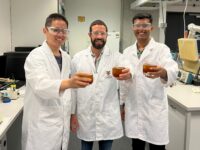
Researchers at UNSW Sydney have developed an ultrasound-based coffee process, reducing cold brew production time from 12-24 hours to about three minutes and cutting energy use by up to 75 per cent.
The technology may have applications for manufacturers of bottled coffee, ready-to-drink beverages and coffee concentrates.
Led by Dr Francisco Trujillo from UNSW’s School of Chemical Engineering, the team developed a new brewing system. It produces espresso-strength coffee using room-temperature water instead of hot water. The findings were published in the Journal of Food Engineering.
Conventional espresso relies on forcing hot water through coffee grounds under pressure. In contrast, the UNSW method uses ultrasound waves to accelerate the extraction of flavour compounds, oils and caffeine without heating the water.
“We call it an ultrasonic espresso. It’s a different process, but you get the same richness and concentration of a normal espresso in under three minutes,” Trujillo said.
The process relies on acoustic cavitation. During this process, microscopic bubbles form and collapse in the liquid. This increases the transfer of flavour compounds and caffeine from the coffee grounds.
According to the researchers, brewing times of between two-and-a-half and three minutes produced the desired balance of concentration and flavour.
Researchers conducted blind taste tests involving about 100 regular coffee drinkers. Participants compared conventional espresso, ultrasound-brewed espresso, and filter coffee prepared using conventional and ultrasound methods.
Results showed no significant differences between conventional espresso and the ultrasound version across the measured categories. For filter coffee, participants preferred the ultrasound-brewed samples overall.
“These findings showed that using ultrasound did not harm taste, and in some cases even improved it, despite brewing at room temperature,” Trujillo said.
For beverage manufacturers, the process could produce espresso-strength coffee concentrate for RTD products. Manufacturers could also transport the concentrate before diluting it into products, including cold brew and milk-based coffee beverages.
“There are companies that make coffee products on an industrial scale and we are confident this ultrasound system can be scaled up to meet their needs, delivering real benefits in terms of reduced processing times and energy use,” Trujillo said.