
Private-label products have long been positioned as cheaper alternatives to national brands. However, South Korean retail giant GS Retail has a more ambitious outlook for the future of private labels: Combining quality, cultural relevance, and consumer insight to create brands shoppers actively seek out.
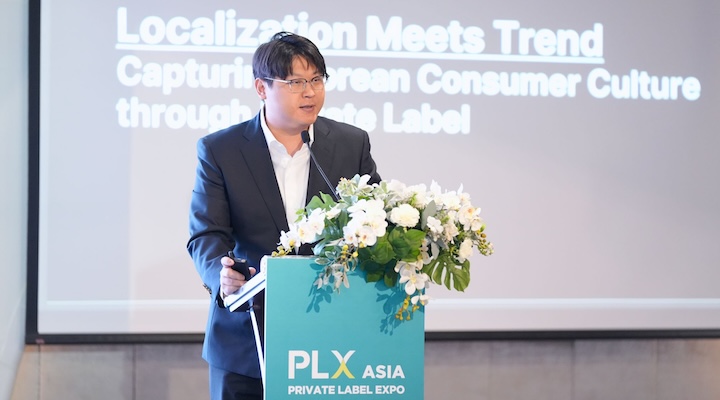
Speaking at PLX Asia – Private Label Expo, held as part of Thaifex Anuga Asia 2026, Eddy Choi, sourcing manager on GS Retail’s global sourcing team, shared how the retailer is rethinking private-label development as it expands both at home and in international markets.
“Customers are much smarter and more sophisticated as well,” Choi said. “It’s not enough to just be cheaper anymore.”
Moving beyond the ‘cheap alternative’
Private labels have long been reviewed as a way to offer lower-priced alternatives to branded products. Choi believes that the approach is becoming increasingly outdated.
Today’s consumers are paying closer attention to ingredients, sourcing, quality and product authenticity. As a result, GS Retail’s private-label strategy starts with meeting quality expectations rather than simply reducing costs.
“Customers are looking at the back of the package now. They want to know where ingredients come from, what’s inside and whether it’s worth buying,” he said.
While affordability remains important, Choi told Inside Retail that GS Retail is unwilling to compromise product quality to hit a target price point. Instead, the retailer works closely with manufacturing partners to find efficiencies elsewhere in the supply chain.
“It’s always a difficult balance, but we start by thinking about the customer,” Choi told Inside Retail.
“We don’t reduce quality to hit a price. Instead, we focus on areas such as logistics, operational efficiencies, or working more closely with manufacturers to achieve better economies of scale across multiple products. At the end of the day, if there’s a trade-off to be made, it’s usually on our margin rather than on product quality. We would rather accept a lower margin than offer customers an inferior product.”
The retailer has established a dedicated private-label task force that continuously evaluates category opportunities, consumer expectations and supplier partnerships as it develops its long-term strategy.
Adding culture to create differentiation
One of GS Retail’s most distinctive approaches to private-label development is its use of Korean cultural trends and entertainment partnerships to make products more engaging.
Choi said retailers often focus on price and quality, but cultural relevance can be equally important in driving customer interest.
“We try to add a little bit of Korean culture into our products to make customers more excited about them,” he shared at the PLX Asia.
The company has collaborated with a range of entertainment brands, celebrities and content creators, most notably Netflix.
Choi pointed to the popularity of Squid Game as an example. GS Retail developed a range of products inspired by the hit series, which generated strong customer interest and positive feedback.
Rather than creating entirely new products, GS retail redesigned and repackaged existing items around popular content themes, turning everyday snacks into products that felt more closely aligned with consumers’ interests.
According to Choi, these collaborations demonstrate that private-label products do not need to compete solely on value.
“What I’m saying is when you’re creating a private label brand and products, it can always be a cheaper, better quality version of the national brand, but adding a little bit of cultural relevance into a product or content could also be a pretty big factor when it comes to bringing differentiated products,” he said.
Building private labels through data and partnerships
Data is becoming increasingly important to GS Retail’s private-label strategy. The retailer combines information from its convenience stores, supermarkets and online channels to identify emerging consumer trends and unmet needs. It also uses AI tools to monitor social media conversations and track changing preferences.
The goal is to translate those insights into new product opportunities before trends become mainstream.
“We’re trying to understand what customers are actually demanding and talking about,” Choi said.
“We have our own AI-powered large language model, which we use alongside customer and market data to identify emerging trends. It helps us generate product ideas and recommendations, while also giving us deeper insights into what customers are saying and looking for, down to very specific details.”
International expansion is also playing an increasingly important role in the company’s private-label ambitions.
Since entering overseas markets such as Vietnam and Mongolia, GS Retail has gained access to a broader network of suppliers and a wider range of consumer insights. The retailer is increasingly using those learnings to explore localised private-label opportunities tailored to different markets.
Choi said the company views itself as a platform that connects customer demand, retail data and manufacturing expertise.
“We work very closely with our manufacturers and view them as long-term partners,” he added. “We then share insights with our manufacturing partners, so building a strong ecosystem between retailers and manufacturers is critical to the success of private-label products. I think that’s one of our key strengths at GS Retail, and we are continuously working to strengthen those relationships.”
As private labels evolve from low-cost alternatives into strategic growth drivers, GS Retail sees collaboration, consumer understanding and cultural storytelling as the foundations of its next phase of growth.
“We’re not just talking about margins, but winning customers’ hearts. And once they start coming, they keep. So we really want to kind of create a brand upon that.”