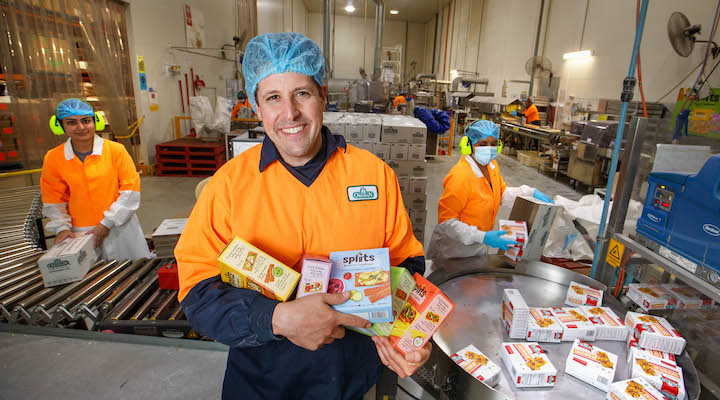

As Australia’s leading producer of allergen- and gluten-free foods with nearly four decades of experience in the space, Roma Foods knows a thing or two about local manufacturing. The family-owned business is a vertically integrated operation with seven production lines, managing everything in-house, from the milling of grain through to blending, production, packing and distribution. Roma’s Orgran and Buontempo brands are market leaders in the health food aisle in Australia and are expo
Unlock indepth features,executive

Unlock indepth features,executive
interviews and quarterly magazines
SUBSCRIBE NOW
Already a Premium subscriber? Log in
Just for$39.95per year
As Australia’s leading producer of allergen- and gluten-free foods with nearly four decades of experience in the space, Roma Foods knows a thing or two about local manufacturing.The family-owned business is a vertically integrated operation with seven production lines, managing everything in-house, from the milling of grain through to blending, production, packing and distribution. Roma’s Orgran and Buontempo brands are market leaders in the health food aisle in Australia and are exported to over 70 countries worldwide.And after a bumper year for the business fuelled by high demand for staple items like pasta and flour during the pandemic, Roma Foods has made the move into the mainstream aisle.“It was a huge year for us,” said Roma Food Products CEO Sam Schachna. “The business [sales] have grown by over 20 per cent and we’ve expanded our team by over 30 per cent.”In February, Roma’s latest pasta and biscuit offerings, Pasta Roma! and Spliits, launched alongside the other big players in the pasta and biscuit aisles at independent grocers.“We are the only Australian made and owned gluten free offer in those mainstream categories, so it’s a very exciting development for us.”According to CSIRO, the growing interest in healthy and sustainable lifestyles is set to be worth $25 billion and make up 10 per cent of the total value of Australia’s food and agribusiness sector by the end of next decade. “Roma has a clear stake in that,” Schachna said. “We have been better for you since day one, we introduced alternative grains into the market.”Industry disruptionSchachna believes the Covid-19 pandemic brought some much-needed disruption to the local grocery sector. “It has been an incredibly challenging time but it’s sparked a renaissance in Australian manufacturing. It’s brought into stark relief the importance of sovereign capability in food manufacturing,” he said. “Almost 12 months ago, we were getting a month’s worth of orders in a day. At the most basic level we had to feed the nation, and for a business like Roma that’s something we take really seriously.”He said there’s never been a better time to be in the local industry, with benefits such as stable supply chains, local job creation, and the ability to accelerate innovation and respond to market demands. “The Spliits and Pasta Roma! lines were developed in six months. For global multinationals, these processes can take 18 months,” Schachna said. Government focus on food also spells good news for the industry. “The food and beverage industry has been identified as a key platform for growth and also recovery,” he said, pointing to the Manufacturing Modernisation Fund, which he said will allow businesses to be “competitive, resilient, innovative and scalable”. Australian manufacturing is also a big benefit when exporting overseas, given the country’s “clean and green” reputation. “That’s a very proud part of our business. It’s about leveraging that reputation. Our export markets have continued to grow because we’ve been able to respond, to supply, when many others couldn’t.”Uneven playing fieldBut the Australian manufacturing landscape is not without its challenges, as local players are all too aware.“It’s not an even playing field for local manufacturers, we don’t have the scale or even local market size compared to others. We’re dealing with price pressures,” Schachna said.“By moving up the value chain and by leveraging our positions of strength, continuing to invest in skills and infrastructure, we will continue to thrive. We invest so that our local presence is our national advantage.”The skills shortage in Australia is an area of concern and one that requires a lot of investment, according to Schachna.Roma Foods has around 120 employees, many long-serving and from the local area. The business recently appointed a new head of people and culture, and is putting learning development programs in place for staff. “Family businesses are the heart and soul of the Australian economy,” Schachna said. “I’ve been in family business my whole life, and for us, we’ve always had a longer-term horizon. We’ve got an outstanding team, so it is about empowering them by accelerating investment in our people.”“Better for you” boomFor Schachna, the future of Australian manufacturing is bright. “We’ve seen a number of structural shifts which have been accelerated by COVID, and they’re here to stay. Government has put a stake in the ground in terms of selecting food and grocery as a key platform for our growth. So I think we’ll see an acceleration of investment within the sector, which will mean more jobs, more capacity and more capability.”He also expects “better for you” to become an even bigger focus as consumers continue to adopt healthier lifestyles.“In the next decade, we’ll see promotion and dedication to a healthier lifestyle truly take the driver’s seat. That’s not just an opportunity for us, that’s an opportunity for all Australian manufacturers,” he said. Schachna is hoping that more local manufacturers jump on the trend and that consumers continue to support local. “I think you’ll be seeing more consumers who are looking to shop local, support local manufacturers and looking to eat better. And all of that is fantastic because it means more jobs and more options for our local industry.”