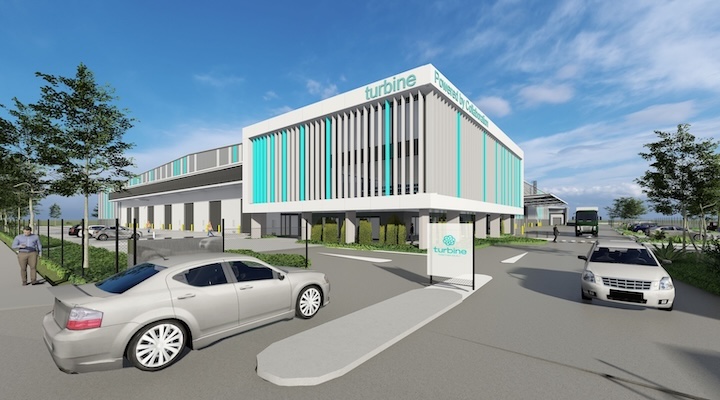

Australia’s first collaborative food and beverage manufacturing precinct is taking shape on the Sunshine Coast, with anchor tenants secured and construction set to begin next year.
Turbine CEO and project manager Andrew Eves-Brown says about 70 per cent of the site’s space is already committed, with the first tenants due to move in early 2027.
“Momentum is building quickly. With planning well advanced and a clear pathway to operation, we are entering the final phase of tenant recruitment,” he says.
Anchor tenants – including a beverage contract manufacturer and a baked goods company expanding from NSW into Queensland – will be revealed soon. Some flexible leasing space remains, with options from 300sqm to 4000sqm, and approved tenants may access non-repayable funding to assist with fit-outs and equipment.
Construction is ready to begin
A developer has been appointed and has completed due diligence. Development approval is in place, with construction scheduled to commence early next year.
Eves-Brown describes the project as more than just bricks and mortar. “This is more than just a building – it’s a transformational ecosystem that will enable food and beverage manufacturers to scale, innovate and access export opportunities with confidence.”
The design is built around shared infrastructure and services – from refrigeration and warehousing to steam, wastewater treatment and R&D facilities – aimed at easing the capital burden on smaller businesses and helping them accelerate growth.
“The very concept of collaborative manufacturing is resonating with people, especially if they are in a really early-stage scale,” Eves-Brown says. “They understand how capital-intensive scaling up can be and how challenging the step changes in productivity that are required. The ability to share services is key.”
Backed by a growing food sector
The precinct builds on the Sunshine Coast’s established strength in food and agriculture, which now generates more than $1 billion annually in GDP. That figure rises to $3 billion when including neighbouring areas such as Moreton Bay, Noosa and Gympie, which collectively produce about 10 per cent of Queensland’s food and agricultural output.
The project’s roots go back a decade, to when the Sunshine Coast Regional Council released its Regional Economic Development Strategy.
“That’s how the idea of Turbine was born,” says Eves-Brown. “Wouldn’t it be great if we had a collaborative precinct where people could share in the infrastructure, some services and some resources? We are about taking away the stress and the challenges of growth.”
Collaboration at the core
Tenants at Turbine will be able to share resources and services, lowering operating costs in the critical early growth years. The model also extends to white-label manufacturing, allowing businesses from outside the precinct to use its facilities.
One of the largest partners is the University of the Sunshine Coast, which will operate the on-site research and development centre. The move will expand the university’s food and agribusiness offering while giving tenants access to R&D capability that would otherwise be out of reach.
“For small food businesses, having that ability to expand through R&D, and having world-class R&D capability on site, is a major drawcard,” Eves-Brown says.
International partners are also signing on. Doehler, a European flavours house with its Australian base in Melbourne, will establish a presence at the precinct to provide flavour development and R&D support to scaling tenants.
Strategic location
Located just 7km from the Bruce Highway, Turbine offers proximity to both domestic and international trade routes. The precinct is 99 kilometres from the Port of Brisbane, 75km from Brisbane Airport, and 30km from Sunshine Coast Airport.
Eves-Brown says the positioning is deliberate: Tenants will be able to move finished products efficiently to markets across Australia and abroad.
Public investment
Turbine is structured as a not-for-profit, with joint funding from the Australian and Queensland governments. Government grants will help contribute to shared services such as wastewater treatment, warehousing and system control.
“This collaborative model is about creating the conditions for food and beverage SMEs to succeed,” Eves-Brown says. “By sharing the infrastructure and resources, we’re lowering the barriers that stop smaller producers from scaling nationally or internationally.”
Looking ahead
With tenancy recruitment in its final stages and construction imminent, the project is on track to house its first tenants in early 2027. For Eves-Brown, the vision is clear: To create a supportive ecosystem that allows food and beverage SMEs to grow into global players.
“The advantage of collaboration drives everything here,” he says. “It’s about helping businesses through the most challenging part of their growth journey – and doing it in a way that builds resilience, innovation and opportunity for the entire industry.”
- For leasing enquiries, visit Turbine’s website here.